Pareto top shares and the 80/20 rule
ID: pareto-top-shares-and-the-80-20-rule

For a nonnegative random variable with finite positive mean, the share of its total amount carried by the largest fraction q of outcomes can be defined by dividing their contribution to the expected value by the whole expected value. For a Pareto distribution, let 0<q≤1 and choose xq=βq−1/α, so that P(X≥xq)=q. If α>1, direct integration givesThis is a share of amount, distinct from the fraction of outcomes. It depends on α, but not on the unit of measurement β.[ref]
T(q)=E[X]E[X1{X≥xq}]=αβ/(α−1)αβαxq1−α/(α−1)=q1−1/α.
Power laws, Pareto distributions and Zipf's law by Mark Newman. Section III.D, pp. 10–11, Eqs. (27)–(28): upper-population share; Newman's density exponent equals alpha+1 in the present tail-exponent convention
For the chosen α=2, the top 20% starts at x0.2=105≃22.361 and carries T(0.2)=0.2≃44.72% of the amount. To make the top 20% carry exactly 80%, solveThe resulting Pareto distribution has a finite mean and infinite variance. The 80/20 rule selects one shape parameter; it is not a universal law, or even a property of every Pareto distribution. For α≤1, the population-share definition above is unavailable because its denominator is infinite; substituting such an α into the finite-mean formula is invalid.
(1/5)1−1/α=4/5⟹α=log4log5≃1.160964.
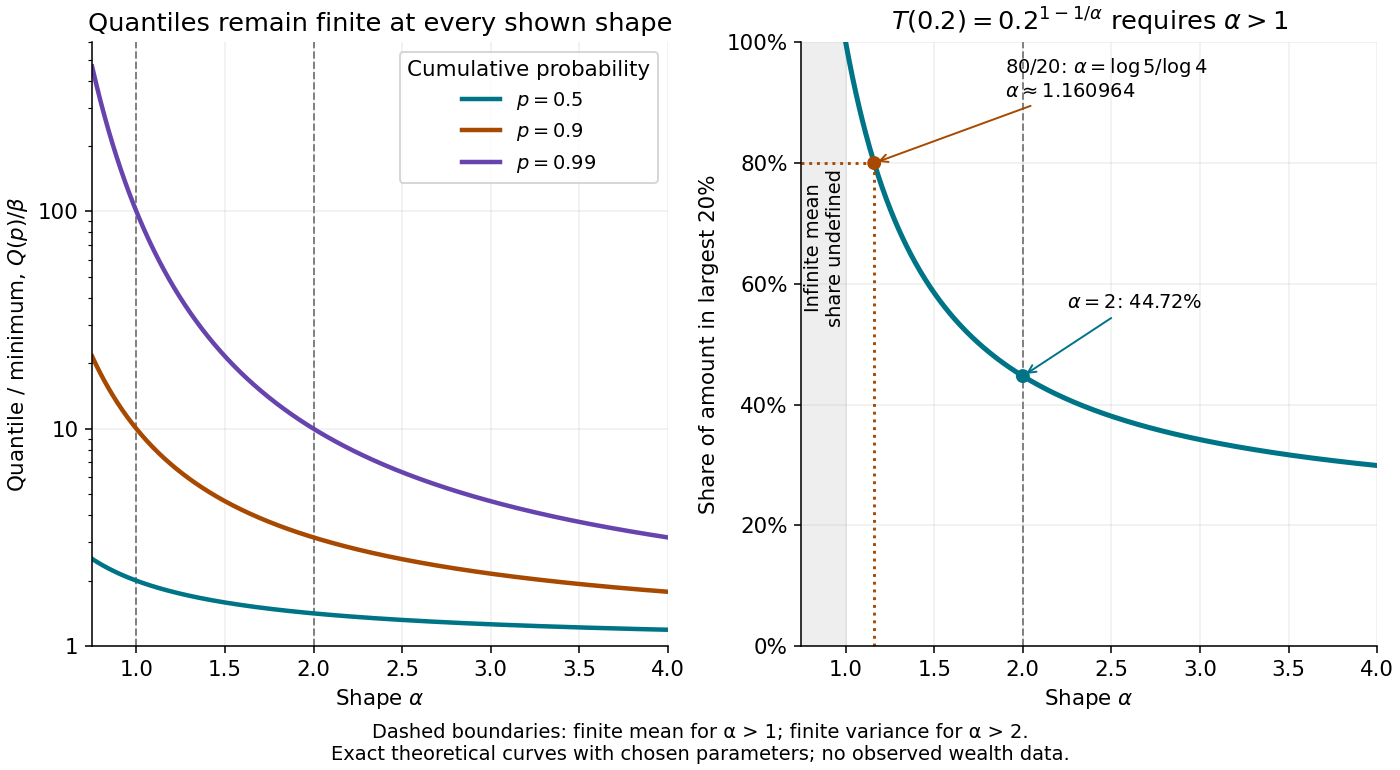

The left panel compares three quantiles in units of the minimum. The right panel shows T(0.2) only where the mean is finite, and marks the chosen 80/20 value. The thresholds α=1 and α=2 separate the moment regimes; they do not separate valid and invalid probability distributions.
A straight-looking empirical log-log plot does not by itself establish a Pareto distribution or a reliable tail exponent; estimating an exponent and assessing goodness of fit are separate tasks.[ref]
Power laws, Pareto distributions and Zipf's law by Mark Newman. Section II, pp. 4–5, Eqs. (3)–(5) and discussion: survival versus density exponent, biases from fitting plotted slopes, and the lower threshold for power-law behaviour
If a Pareto distribution is used only above a fitted lower threshold, T(q) describes that conditional tail population, not automatically the whole population. A genuine finite upper cutoff gives a truncated distribution with finite nonnegative moments; its survival function, quantiles and top shares must be recalculated. Truncation is a modelling change, distinct from merely observing a finite sample. None of the chosen numbers here estimates an actual wealth distribution. New to topics? Read the docs here!