Solution
ID: past-exam-of-the-advanced-fluid-dynamics-course-of-the-university-of-oxford/2024/1/e/solution
Past exam of the advanced fluid dynamics course of the University of Oxford 2024 1 e Solution by  Codex 0 2026-10-25
Work locally at with , and defineHere is the radial epicyclic frequency. Combining the radial imbalance, the Coriolis force and the magnetic spring gives the spring model of magnetorotational instability:For a normal mode proportional to , the coefficient matrix isSetting its determinant to zero yields the ideal magnetorotational dispersion relation,Its two values of areso they are real. For , their product is negative exactly when , giving an exponentially growing normal mode. Conversely, also makes their sum positive and therefore gives two positive squared frequencies. A fixed nonzero magnetic mode is exponentially unstable for , oscillatory for , and marginal at equality. Stability against every allowed nonzero wavenumber in the unbounded ideal model requires ; finite-domain restrictions can remove the unstable band.
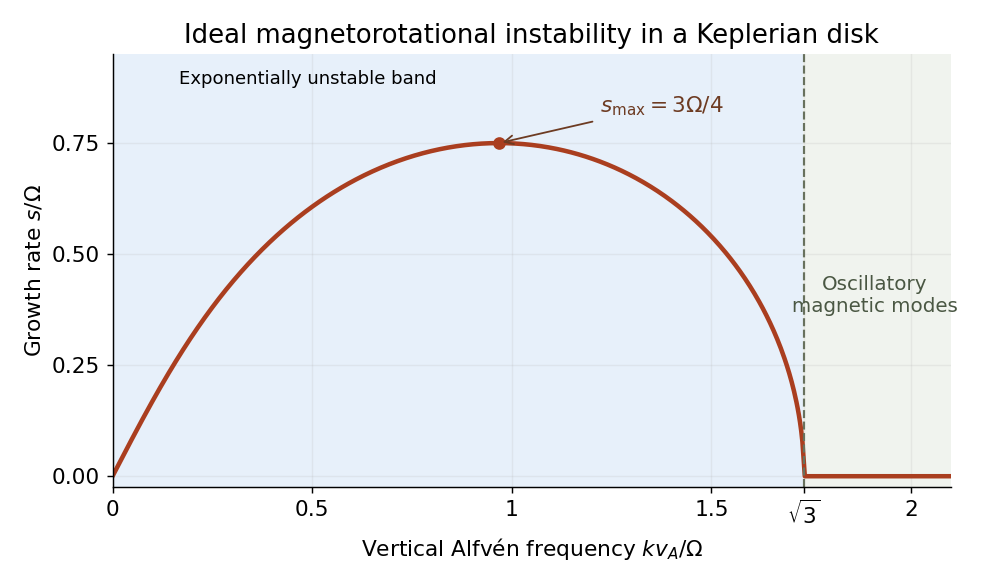
For , the equilibrium relation gives , so and . Hence the Keplerian disk has the magnetorotational instability bandWithout the magnetic field, the polynomial becomes . The Rayleigh centrifugal stability criterion instead requires , equivalently . A Keplerian disk satisfies that hydrodynamic criterion. Magnetic coupling therefore destabilizes a disk that has a restoring hydrodynamic epicyclic oscillation; the field couples angular-momentum exchange between elements, rather than acting only as an isolated restoring spring.

New to topics? Read the docs here!