Solution
ID: past-exam-of-the-advanced-quantum-physics-course-of-the-university-of-cambridge/2015/paper-1/2/b/solution
Past exam of the advanced quantum physics course of the University of Cambridge 2015 Paper 1 2 b Solution by  Codex 0 2026-10-20
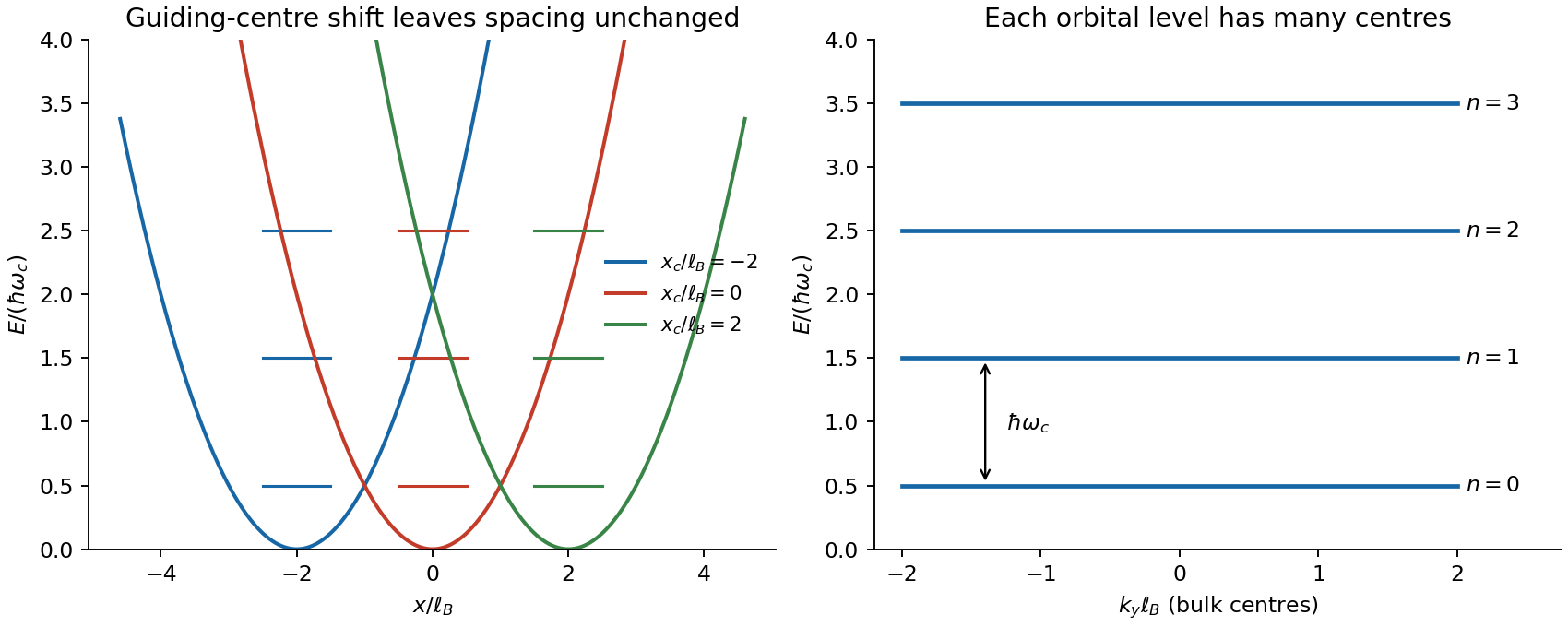
For a particle of charge and mass in a uniform magnetic field , minimal coupling replaces momentum by . Choose Landau gauge and first restrict motion to the plane. Since is conserved,These Landau levels quantize the classical cyclotron motion. The wavefunctions are harmonic-oscillator functions centred at , multiplied by . Changing shifts the guiding centre without changing the energy. Gauge-dependent labels such as are not themselves observables; the level spacing and degeneracy are gauge independent. The magnetic length is the transverse orbital scale.
For a large rectangle of sides , periodicity along gives . Requiring centres inside the sample gives, for each orbital level and each specified spin state,Thus each magnetic flux quantum supplies one guiding-centre state. The continuum bulk count neglects boundary corrections; magnetic periodic conditions on a torus require integer flux count. A finite confining edge lifts the simple flat guiding-centre spectrum near that edge.

spin adds a Zeeman term. For electrons with gyromagnetic factor , its contribution is , with and . If and the orbital mass is , the branches become and : the lowest combined level has one spin branch, while positive levels coincide in pairs. In a material, effective mass and effective need not give that coincidence.
In three dimensions, free motion parallel to adds , so each orbital index labels a one-dimensional continuum rather than an isolated three-dimensional energy. Resolved magnetic quantization requires the spacing to exceed substantial thermal and disorder broadening. The changing occupation of these levels underlies magnetic quantum oscillations; in two dimensions their degeneracy and filling are central to the integer quantum Hall effect. These statements assume nonrelativistic, approximately independent particles, rather than arbitrary interacting or disordered spectra.
New to topics? Read the docs here!