On an ideal integer plateau, the magnitude of transverse sheet conductivity is , where is a positive integer, while the longitudinal sheet conductivity vanishes. The measured transverse electrical resistance is then . Both statements matter: inverting a conductivity tensor mixes its longitudinal and transverse components, as the quantum Hall conductivity tensor inversion shows.
The von Klitzing constant is . The current SI fixes the Planck constant and elementary charge exactly, so is exact; the displayed decimal is truncated. It differs from the historical conventional value .[ref]
Fundamental Physical Constants — Complete Listing by National Institute of Standards and Technology and others. 2022 CODATA adjustment: Planck constant, elementary charge, von Klitzing constant and conventional-value rows
As an original ideal example, and electric current give . Changing the Hall bar's width changes the transverse electric field required for this electric potential difference, while the ideal ratio remains .
Klaus von Klitzing, G. Dorda and M. Pepper reported a silicon MOSFET measurement in 1980. Its gate controlled an semiconductor inversion layer; transverse contacts measured the Hall voltage and separate longitudinal contacts measured dissipation. One sweep held , and fixed while varying gate voltage. Hall plateaus accompanied small longitudinal voltages. Device-geometry comparisons and high-input-impedance voltage measurements helped test whether contact placement or electrical loading produced the result.[ref]
New Method for High-Accuracy Determination of the Fine-Structure Constant Based on Quantized Hall Resistance by Klaus von Klitzing and others. pp. 494–496, Fig. 1 and precision-measurement discussion
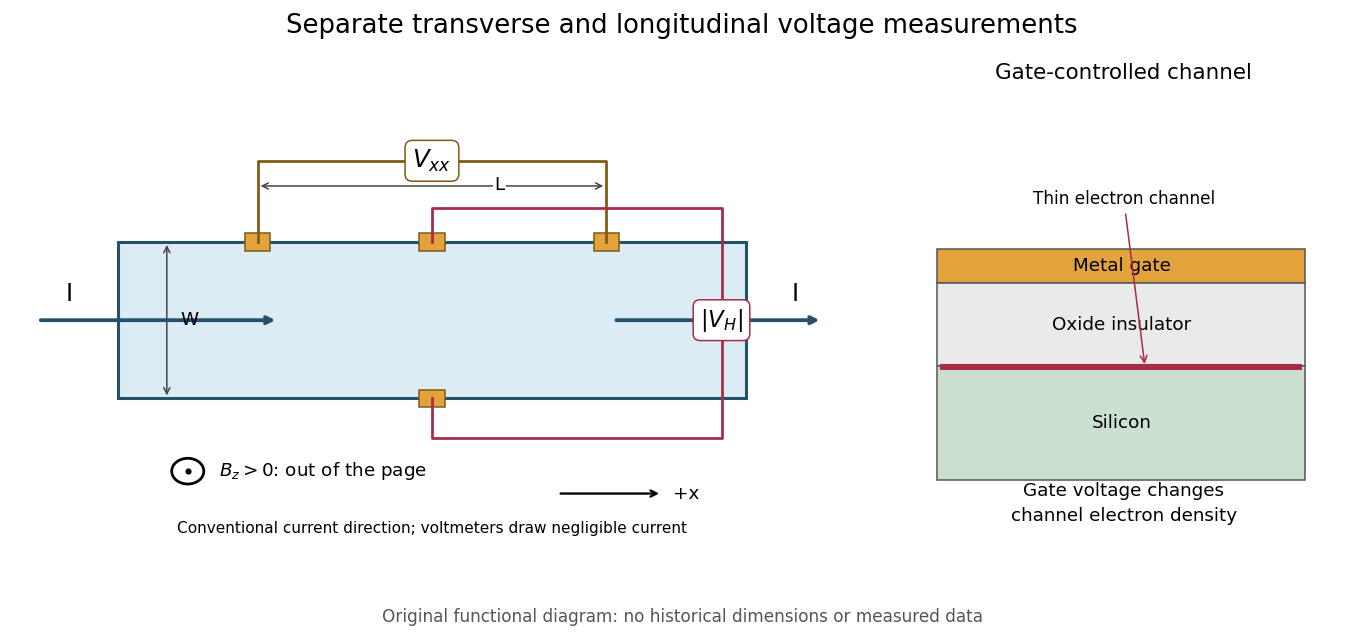
This original functional diagram separates transverse and longitudinal readouts; it does not reproduce the historical device's dimensions. The gate inset explains how a field-effect transistor provides an adjustable two-dimensional electron gas. A longitudinal voltage close to zero is a useful check because accidental longitudinal separation between Hall contacts can otherwise contaminate the transverse measurement.
A Hall bar is a strip with current contacts at its ends and additional voltage contacts along its sides. Opposite-side contacts measure a transverse electric potential difference; same-side contacts at different longitudinal positions measure a longitudinal electric potential difference. Separate voltage leads reduce the influence of current-contact electrical resistance when their input electric currents are negligible.
Voltage contacts separated along the current direction measure longitudinal resistance, even when the device is called a Hall bar. For an approximately uniform rectangular strip, . Transverse contacts measure instead. Shubnikov-de Haas effect oscillations in need not be Hall-resistance plateaus; in the integer quantum Hall effect, longitudinal minima accompany quantized transverse plateaus.
The degeneracy of a Landau level is per resolved internal branch in area . The filling factor varies continuously. Additional localized eigenstates need not carry bulk transport, allowing an integer plateau over an interval of ; a mobility gap need not be an empty spectral gap.[ref]
Quantized Hall Conductance in a Two-Dimensional Periodic Potential by D. J. Thouless and others. p. 405, gaps and localized tails
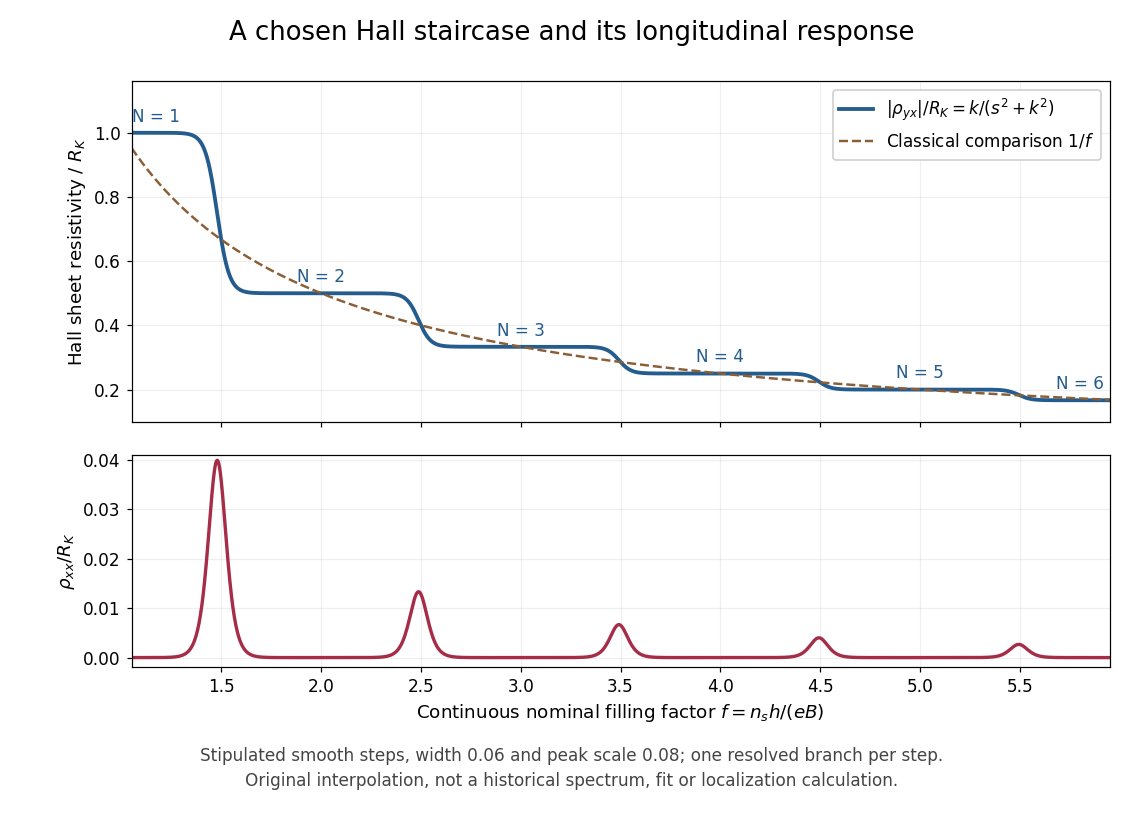
The plot is an original phenomenological construction, not measured data or a calculation of Anderson localization. It stipulates dimensionless transverse sheet conductivity and longitudinal sheet conductivity , with chosen , . Both are measured in units . The quantum Hall conductivity tensor inversion produces and . Regions near , yield plateaus near ; the model alone does not explain their microscopic robustness. Each step represents one resolved branch, without assuming unresolved spin or valley multiplicities.
Choose conventional surface current density along , magnetic field along , and negative Electron charge. An isotropic in-plane response has the following sheet conductivity and sheet resistivity tensors for , :These are matrix inverses, rather than componentwise reciprocals. The sheet conductivity has units siemens, the sheet resistivity ohms. With , the sign is , agreeing with the negative Hall coefficient of a single Electron species. Contact polarity can reverse the measured voltage sign, so quote the Hall magnitude. For a homogeneous strip of width and longitudinal probe separation , givesAt , , these reduce to and zero. A nonzero transverse sheet resistivity creates no local Joule heating: the antisymmetric contribution cancels in .
For an original nonideal example, choose , and . Then , while the Hall magnitude is below by the relative amount parts per million. An unwanted admixture in the Hall readout would instead introduce approximately . The chosen calculation shows why a small intrinsic tensor correction does not by itself guarantee an accurate contact measurement.
For filled, separated, noninteracting magnetic Bloch bands, the Berry curvature integral over the magnetic Brillouin zone is an integer Chern number , giving . Patches of Berry connection meet through phases with integer windings; continuous gap-preserving changes cannot change . D. J. Thouless, M. Kohmoto, M. P. Nightingale and M. den Nijs developed this band argument; it does not establish the interacting fractional case.[ref]
Quantized Hall Conductance in a Two-Dimensional Periodic Potential by D. J. Thouless and others. pp. 405–407, Kubo formula and phase winding
A quantum Hall edge state is confined across a boundary but can extend along it and carry electric current. B. I. Halperin related these current-carrying boundary states to quantized Hall transport in a disordered two-dimensional system.[ref]
Quantized Hall conductance, current-carrying edge states, and the existence of extended states in a two-dimensional disordered potential by B. I. Halperin. Publisher abstract: transverse confinement, perimeter extension and current



