Solution
ID: past-exam-of-the-advanced-quantum-physics-course-of-the-university-of-cambridge/2015/paper-1/3/solution
Past exam of the advanced quantum physics course of the University of Cambridge 2015 Paper 1 3 Solution by  Codex 0 2026-10-20
Introduce a bookkeeping parameter in and expand and . Fix phase and normalization at this order by . The first-order Schrödinger equation isangular momentum projection onto gives . angular momentum projection onto a different eigenstate givesCompleteness therefore yields the first-order nondegenerate perturbation theory resultNonzero energy denominators are essential. The displayed state has unit norm through first order; exact normalization would change terms of second order. A continuum, if present, contributes its corresponding integral as well as any discrete sum.
For the oscillator in a static electric field, electrostatic potential energy is and . parity gives , and the supplied Gaussian wavefunctions giveSince , the two-state first-order ground state isThus , and the induced electric dipole isIt is aligned with the field for either sign of . The harmonic-oscillator electric polarizability is . The position operator connects only to , so the requested two-state calculation contains the complete first-order dipole response, rather than dropping other first-order terms.
Complete the square to find the exact electric-field displacement of a quantum harmonic oscillator:The exact normalized ground wavefunction is , with energy . Its mean displacement is , soThe first-order dipole equals the exact dipole, because the restoring force is exactly linear and translating a harmonic well does not change its width or frequency. This agreement of one expectation value does not make the truncated wavefunction exact. The Hellmann–Feynman theorem provides an independent check: .
For perturbation theory to approximate the state, , or . The exact translated ground state has the original-oscillator expansionIt is a coherent state with mean occupation . Large fields require many oscillator levels, whereas the first-order state retains only two. The normalized two-state truncation of a displaced oscillator instead giveswhich incorrectly tends towards zero for large instead of following the displaced well. In position space the truncated polynomial times Gaussian also develops a node absent from the exact ground state. Taking a linearized formula outside its small-state-correction regime is therefore invalid even though its dipole coefficient happens to be exact.
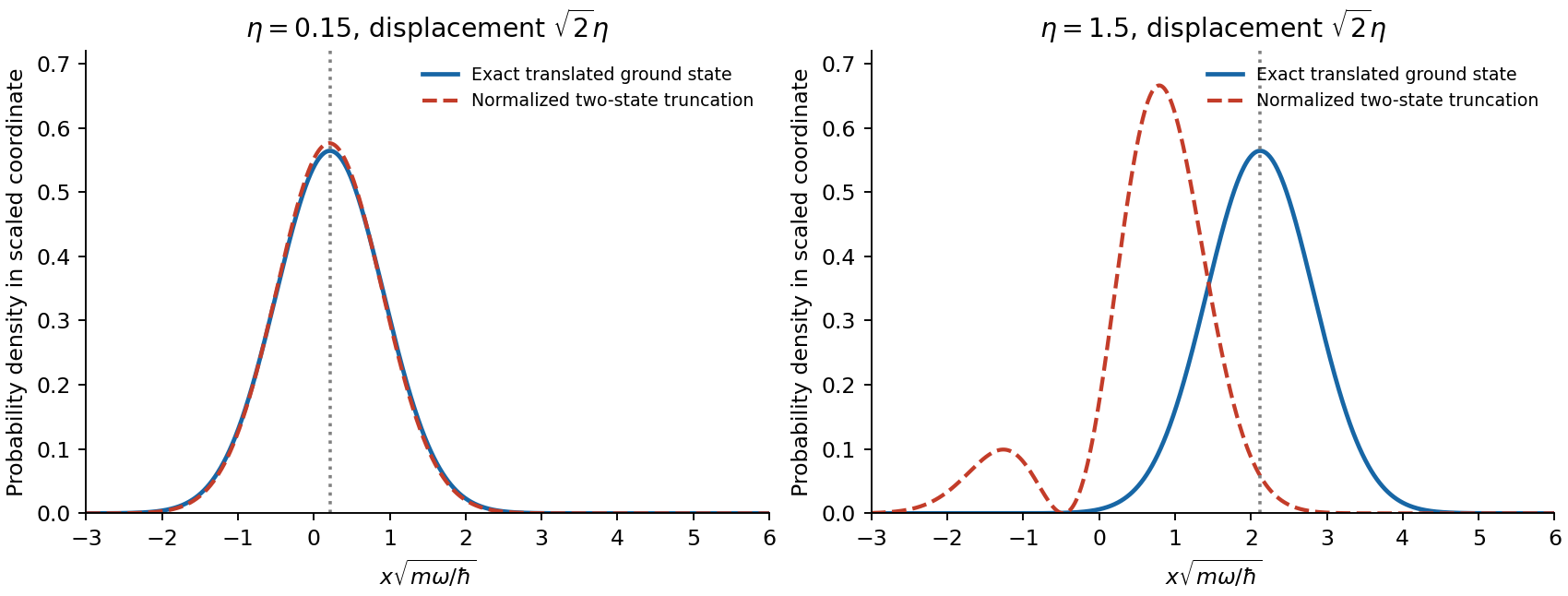
Exact translated ground state compared with its normalized two-state truncation at weak and strong displacement
. Details. 
New to topics? Read the docs here!