Solution
ID: past-exam-of-the-advanced-quantum-physics-course-of-the-university-of-cambridge/2016/paper-1/2/b/solution
Past exam of the advanced quantum physics course of the University of Cambridge 2016 Paper 1 2 b Solution by  Codex 0 2026-10-20
Stimulated emission adds a photon to an already occupied radiation mode; spontaneous emission can occur when that mode initially contains no photons. In the electric-dipole approximation the atom-field interaction is . Quantizing the radiation field makes the emission matrix element into a mode with occupation proportional toThis photon occupation enhancement of emission makes the emission rate into that mode proportional to : the part proportional to is stimulated and the remaining part is spontaneous. Absorption is proportional to . The photon energy is the atomic energy difference, up to any specified recoil or line broadening.
The stimulated contribution preferentially populates the stimulating mode, including its propagation direction and polarization; it provides optical gain. Spontaneous photons populate the available modes according to the transition's dipole matrix elements and radiation environment. They are not universally isotropic. An excited bare atom with the field vacuum is not an eigenstate of the fully coupled Hamiltonian, which resolves the apparent paradox of a nominally stationary excited state radiating.[ref]
Topics in Quantum Mechanics by David Tong. §4.3.2, why the electromagnetic field must be included to describe spontaneous decay
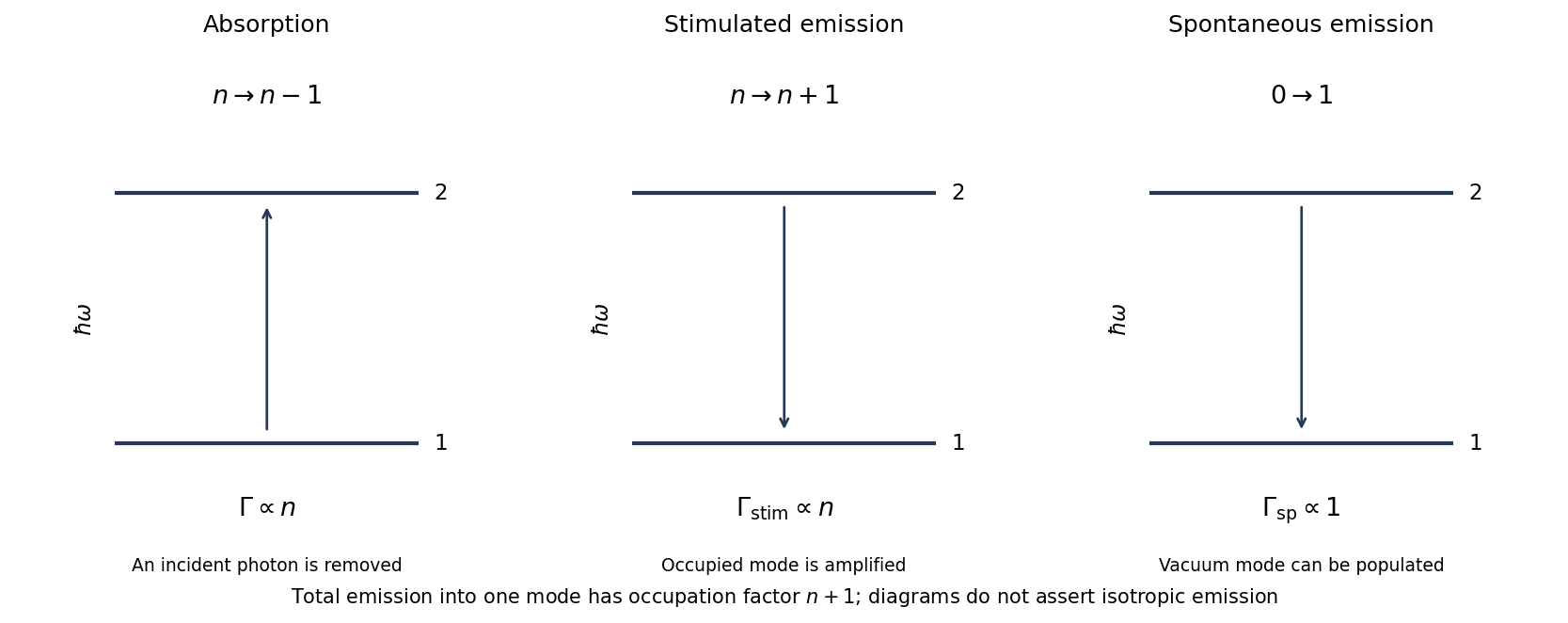
Original two-level transition diagrams and the versus occupation factors for photon absorption and emission
. Details. 
For lower and upper levels 1 and 2, with radiation spectral energy density per unit ordinary frequency, the rates areThermal detailed balance with the Planck spectrum givesThe statistical weights here are level degeneracies, not Landé g-factors. A definition of multiplying intensity or angular-frequency density would change the normalization factors.
For a specified free-space electric-dipole transition, summing radiation modes givesAppropriate sums over final magnetic substates and averages over initial substates are needed for an unresolved degenerate level. The radiative lifetime is only when this is the sole decay channel. In a laser, net stimulated gain requires , as well as sufficient gain to overcome cavity loss; population inversion alone does not specify the lasing threshold.
New to topics? Read the docs here!