Stimulated emission is emission induced by incident light, in contrast with the unprompted decay in spontaneous emission. It supplies the amplification mechanism of a laser. [ref].
For an emitter with upper and lower energy values , the resonant photon has frequency satisfyingwhere is the Planck constant. In the elementary photon picture, an incident photon stimulates an emitter in the upper quantum state to emit an additional photon into the same optical normal mode, with the same frequency, propagation direction and photon polarization. The emitter supplies the extra energy; the stimulating photon is not consumed. This builds the existing field and its optical coherence. An emitter in the lower quantum state can instead undergo photon absorption, so stimulated emission alone does not establish net optical gain.
For example, a gap corresponds to and a vacuum wavelength of about . One ideal stimulated emission event converts one incoming photon into two outgoing photons in the selected optical normal mode, adding of light energy while lowering the emitter's energy by that amount.
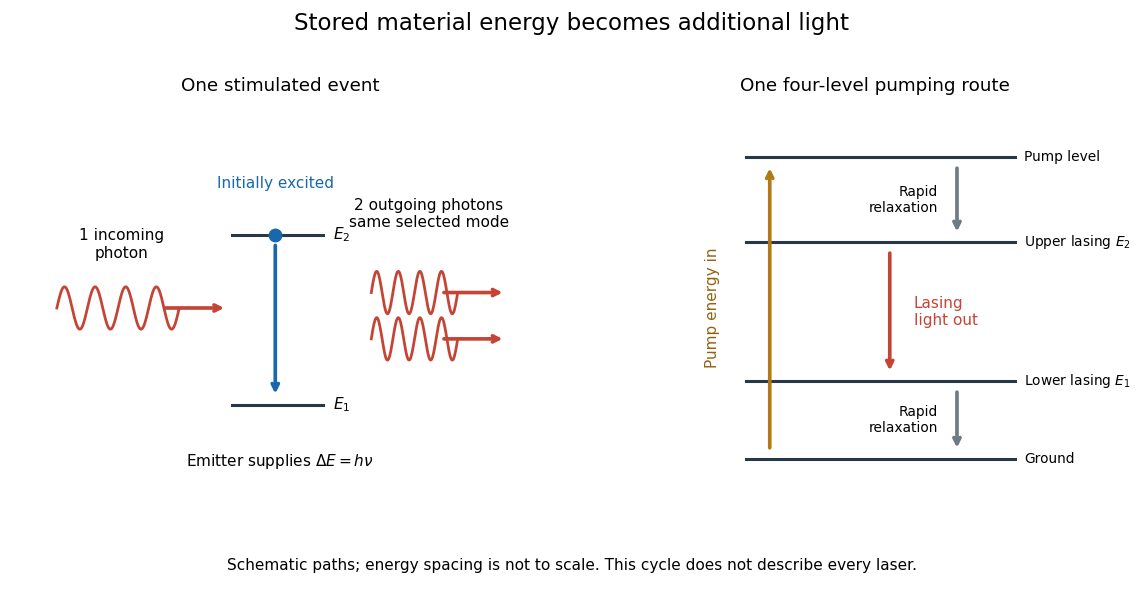
Stimulated emission and one illustrative four-level laser pumping cycle
. Left: one incoming photon induces an additional photon while the emitter falls from to . Right: pumping supplies energy, rapid relaxation feeds the upper lasing state, stimulated emission supplies light, and rapid lower-state relaxation completes a four-level cycle. These paths are schematic, not universal to all lasers; line spacing is not to scale. Details. Articles by others on the same topic

Stimulated emission is a fundamental process in quantum mechanics and is key to the operation of lasers (Light Amplification by Stimulated Emission of Radiation). It occurs when an excited atom or molecule, which has absorbed energy and is in an excited state, is induced to emit a photon (a particle of light) of a specific wavelength.

