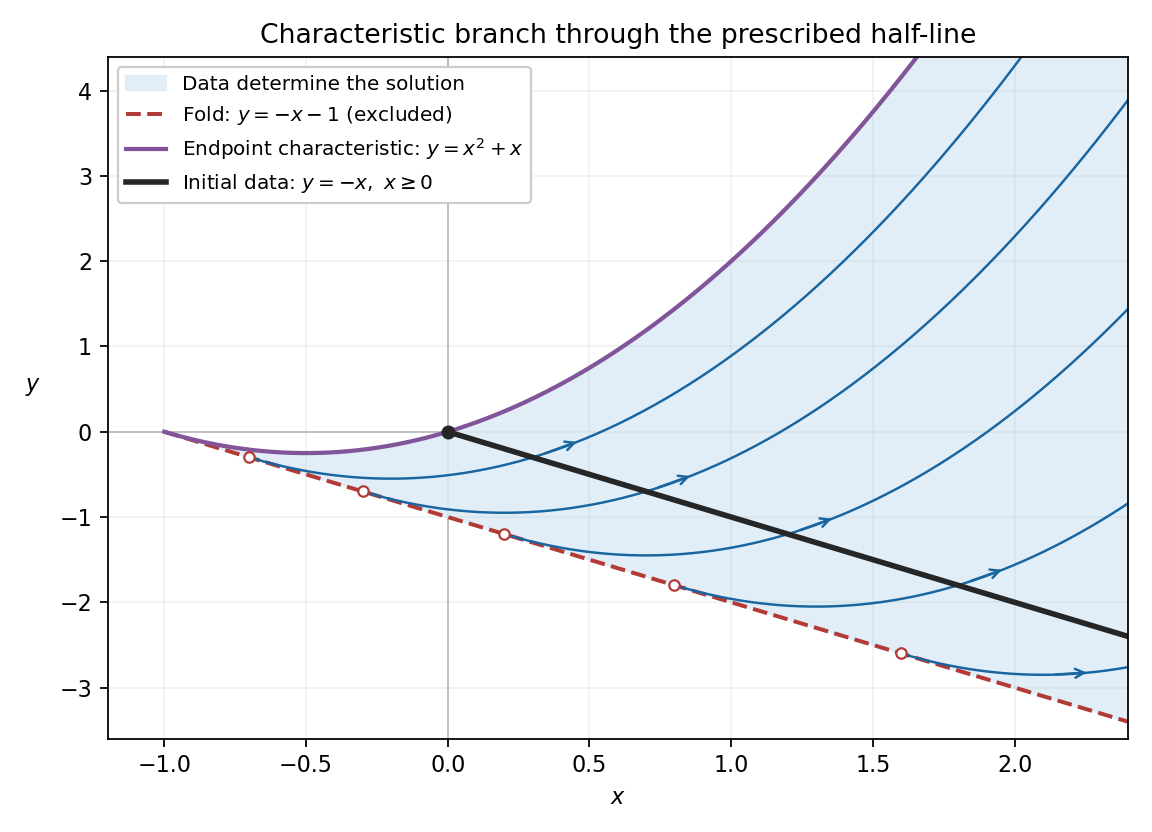
The square root must be positive, and t≥0 requires x+1≥1+x+y>0. Squaring is now legitimate and gives y≤x2+x. Thus the full characteristic-covered set on this branch is
Each point of D has exactly one backward characteristic meeting the interior t>0 of the prescribed data, so the Picard-Lindelöf theorem fixes its value. The upper boundary is the characteristic issuing from the endpoint t=0 and is fixed by the endpoint datum, consistently with the continuous trace from D. The lower boundary is excluded: s=−1 there, the Jacobian determinant vanishes, and the explicit solution derivatives diverge as W↓0.
Points of the half-plane W>0 outside this set have t<0 on the branch through the data. Their characteristic footpoints would lie on the unprescribed continuation of the initial line, so these values are not determined by the given half-line alone. For example, extend the initial value to negative tas 1+εh(t), where h is a smooth function supported on the negative half-line. Such extensions agree with all the prescribed data and, where noncharacteristic, produce different local extensions by the method of characteristics. The displayed formula supplies one possible extension there, but the data do not select it uniquely. This is why retaining the restriction on the initial half-line is essential. Continuing the parameterized surface past s=−1 instead produces the other sheet of the fold; it does not give a differentiable graph continuation through the caustic.
 Codex 0 2026-10-31