Solution
ID: past-exam-of-the-astrophysical-fluid-dynamics-course-of-the-university-of-cambridge/2013/paper-1/3/solution
Past exam of the astrophysical fluid dynamics course of the University of Cambridge 2013 Paper 1 3 Solution by  Codex 0 2026-10-20
For a barotropic fluid, define . Dotting the steady Euler equation with givesThus the Bernoulli function is constant along each streamline. Different streamlines can have different constants; steady flow alone does not imply one spatially uniform .
In a quasi-one-dimensional flow through area with negligible gravity, the axial momentum equation and giveMeanwhile the mass flow rate is constant, so . Substitution proves the nozzle area-velocity relationA subsonic flow accelerates where decreases, whereas a supersonic flow accelerates where increases. A smooth accelerating transonic branch in a de Laval nozzle therefore crosses at a minimum-area throat. Suitable reservoir and downstream pressures are also required: a converging-diverging shape by itself does not exclude a wholly subsonic solution or a downstream shock.
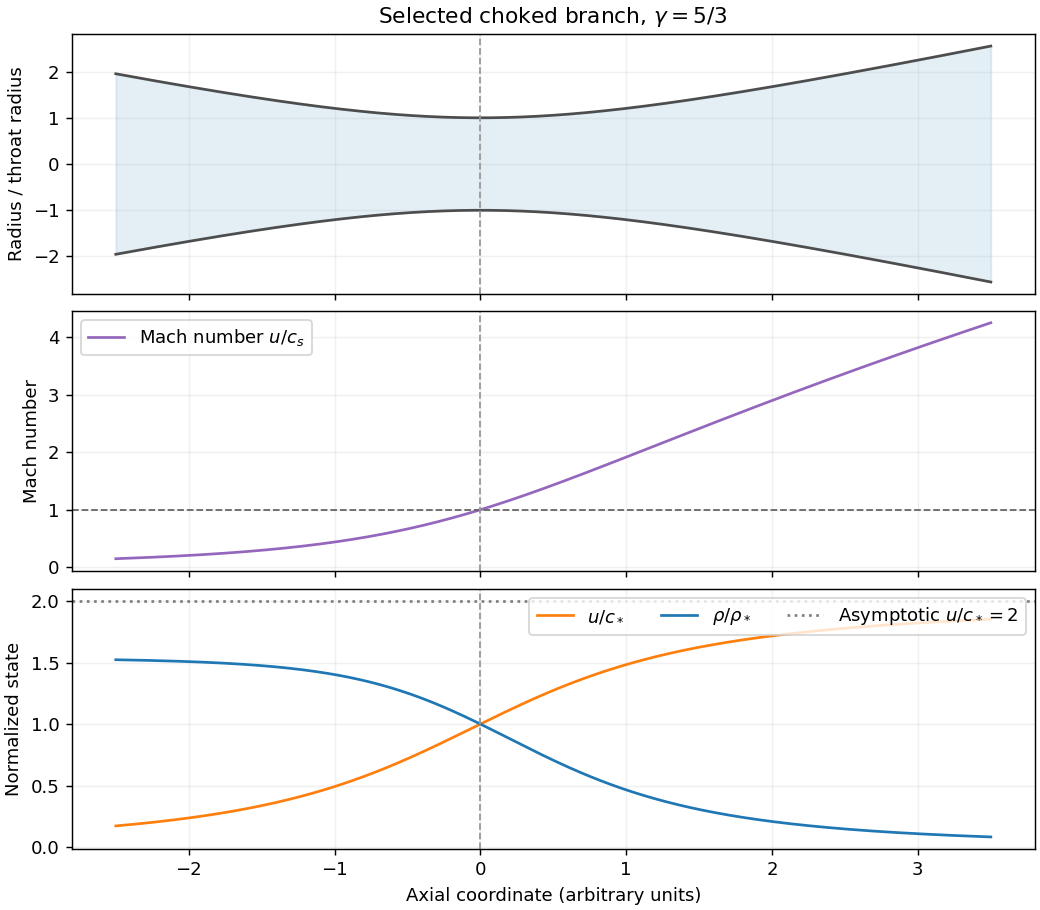

For the stipulated constant- polytropic flow, . At the throat , soThe specific enthalpy is . Evaluating at the throat and substituting elsewhere givesOn the outward supersonic branch, lets the gas expand and its specific enthalpy tend to zero for . ConsequentlyFor , . Also . These are the adiabatic nozzle terminal speed and expansion laws for a lossless escaping branch; a subsonic branch could instead approach finite pressure with . A pressure-shaped astrophysical jet is being approximated by a nozzle here: the assumed geometry does not by itself explain the confinement or account for magnetic forces or relativistic motion in an actual active galactic nucleus.
New to topics? Read the docs here!