Solution
ID: past-exam-of-the-astrophysics-course-of-the-university-of-oxford/2015/4/c/solution
Past exam of the astrophysics course of the University of Oxford 2015 4 c Solution by  Codex 0 2026-10-25
Let the mean particle mass be , with counting total particles so that . The ideal-gas law and the strong-shock pressure give the immediate post-shock temperatureThe robust prediction is . For a transparent numerical convention take , and . ThenFor an ionized mixture with under the same total-particle-density convention, these normalizations become pc and K. The paper does not specify composition or whether its quoted density instead counts hydrogen nuclei; that convention must be stated, not hidden in a precise age.
The ambient-temperature limit of an adiabatic blast wave gives a formal matching estimate, K, givesWith the age is about yr and the radius stays about 90 pc. This matching criterion already lies outside a very strong shock: in the strong-shock formula corresponds to . A separate sonic estimate gives about yr and 133 pc for ; neither extrapolation is a precise transition solution. Using increases these inferred matching ages and radii by factors .
In a real supernova remnant, substantial radiation losses commonly end the energy-conserving phase before these formal pressure-merging limits. The relevant comparison is against the expansion time. A cooling function, composition and ionization state are needed to calculate that earlier age and radius; they are not supplied. The numerical values above answer the ambient-temperature breakdown estimate under explicit assumptions and must not be presented as a uniquely determined radiative shell-formation age.
After cooling, an interior-pressure-driven shell can approximately follow while pressure remains important. In the limiting momentum-conserving stage, and give . Ultimately ambient pressure and turbulent motions make the disturbance merge with the ISM. These slower stages respect the reduced energy budget rather than continuing an adiabatic strong-shock law indefinitely.
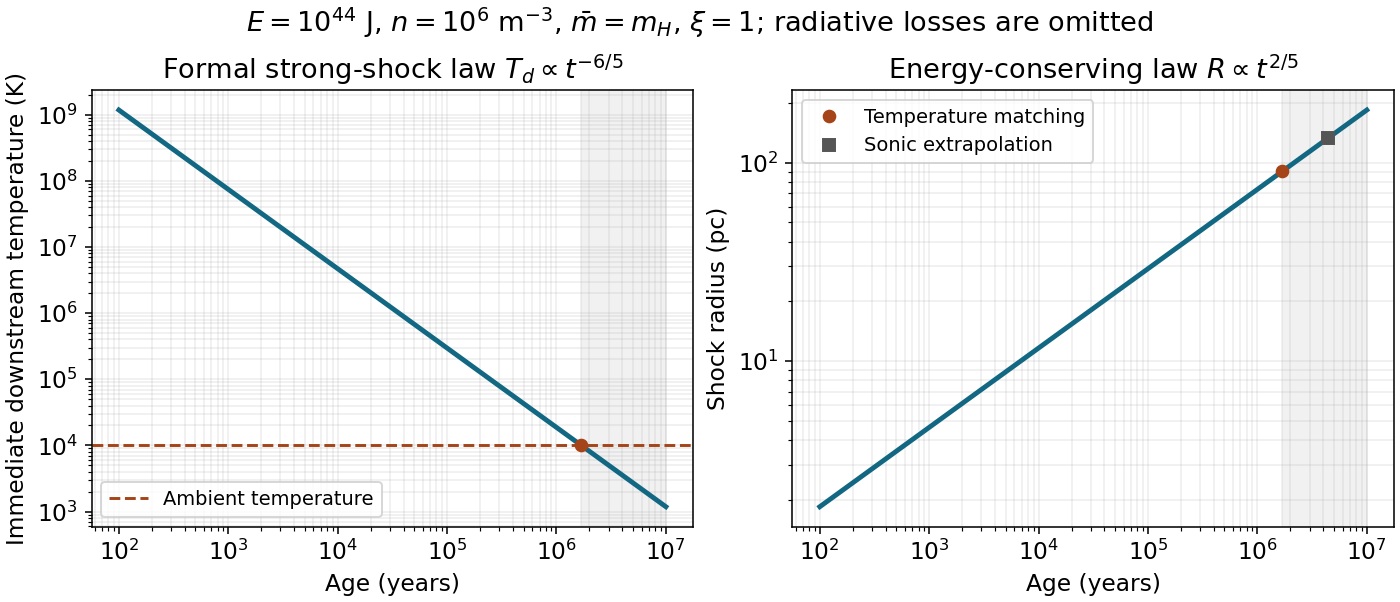
The formal energy-conserving supernova shock temperature and radius, with ambient-temperature and sonic matching distinguished
. Details. 
New to topics? Read the docs here!