Solution
ID: past-exam-of-the-biological-physics-course-of-the-university-of-oxford/2018/1/b/solution
Past exam of the biological physics course of the University of Oxford 2018 1 b Solution by  Codex 0 2026-10-25
The source potential rises from zero to over the half-turn from to , then falls over the next half-turn. Its slopes are . Torque is minus the angular derivative of potential; in the detached state is angle-independent and exerts no torque. A uniform set of motor phases therefore givesHere is an energy and a torque because the angle is in radians. The average over a full turn divides by , rather than by the bound-state occupation alone.
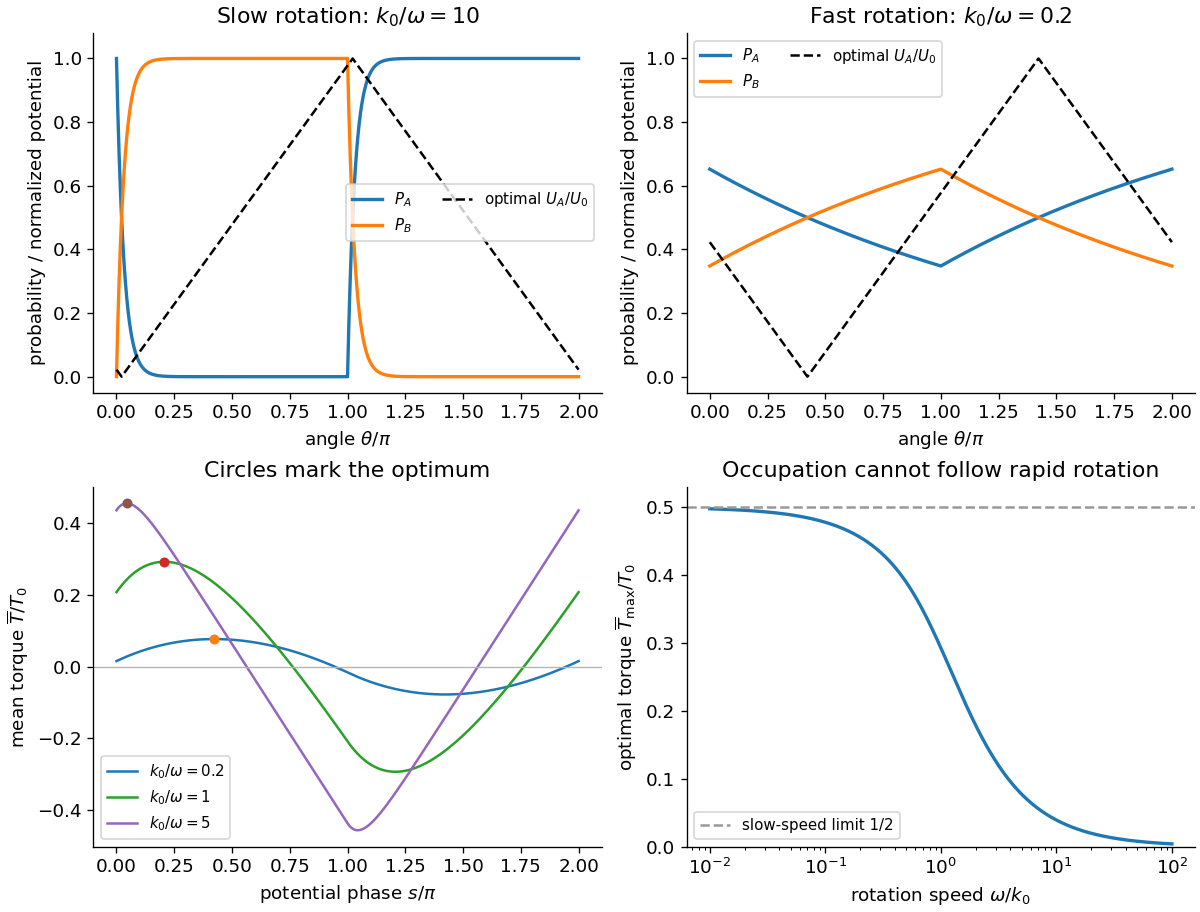
Differentiating the moving integration limits and using periodicity givesThe optimal phase of a two-state rotary motor follows on : decreases, so the stationary point is a maximum and satisfiesThe crossing displaced by is the corresponding minimum. For slow positive rotation, lies just after the detachment switch. The potential then rises mainly while the motor is detached and falls mainly while it is bound. For fast rotation, , with only a small phase-dependent occupation available to produce torque. The potential should still be shifted by this optimum, rather than aligned arbitrarily with a rate switch.
The half-turn symmetry gives . At the optimum, direct integration of the two exponential pieces gives . Thus a useful exact check isFor fast rotation, instead tends to zero. The original plots below show the calculated probabilities and optimized potential shapes. The imposed switching rates constitute driven kinetics: their strictly one-way windows are not equilibrium detailed balance at a fixed angle. Sustained work requires the motor's chemical/ion-gradient energy supply, not extraction of work from a passive single thermal bath.

New to topics? Read the docs here!