Solution
ID: past-exam-of-the-biological-physics-course-of-the-university-of-oxford/2018/5/d/solution
Past exam of the biological physics course of the University of Oxford 2018 5 d Solution by  Codex 0 2026-10-25
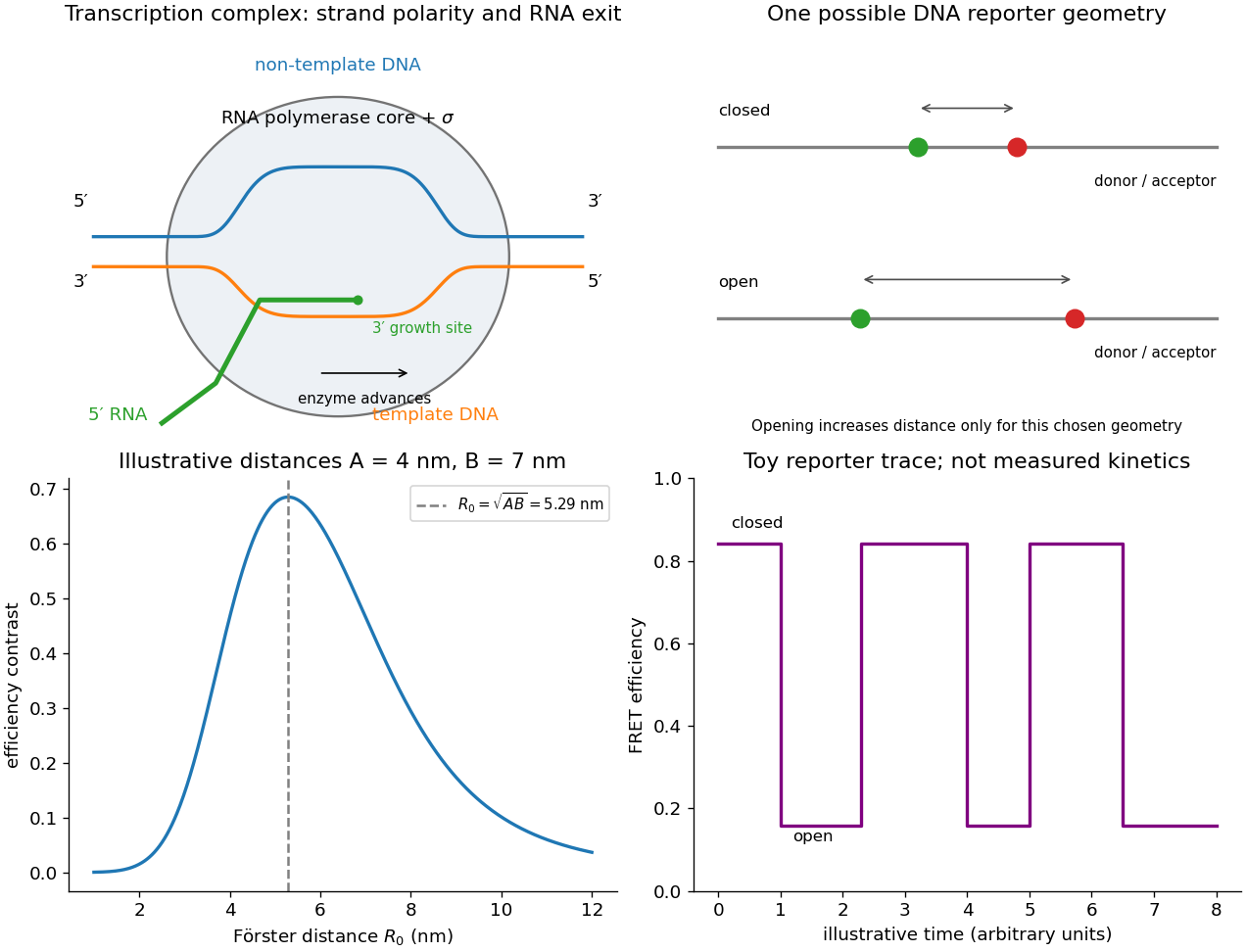
Place a FRET donor and FRET acceptor on DNA positions whose separation reports start-site opening, using an independently calibrated closed/open geometry and a pair whose Förster distance is near the geometric mean from part (c). Opening may increase or decrease the measured separation depending on where the dyes are placed; anticorrelated donor/acceptor changes need structural and photophysical controls before being assigned to bubble formation.
Single molecules can be observed by low-background fluorescence microscopy while recording FRET donor and sensitized FRET acceptor photons. Correct background, spectral leakage, direct FRET acceptor excitation and unequal detection/quantum-yield factors before calculating efficiency, for example with the corrected intensities. Alternating excitation or independent FRET acceptor observation checks that a low-FRET interval is not simply a dark or bleached FRET acceptor. Intensity anticorrelation, FRET donor lifetime and suitable inactive/closed-state controls strengthen the assignment. The original figure below separates the mechanistic schematic from a purely illustrative model trace.
For the binding-plus-opening first-passage time, a minimal kinetic scheme is , for unbound, closed bound and open bound states. A binding rate , dissociation rate and opening rate already produce multiple waiting-time contributions. With O treated as absorbing during the measurement and starting from U, the mean first-opening time isnot simply . This follows from and . A bound-state marker, or measurements over concentration and a justified kinetic model, helps distinguish binding from opening when unbound and closed DNA share a FRET level.
Fit transitions and dwell distributions with finite time resolution, missed short states, bleaching and censoring included. An open-state exponential dwell can estimate its exit rate under a simple Markov model, while competing closing and dissociation channels require separate observables or additional assumptions. Starting from a defined bound closed state can isolate opening more directly, but dissociation still competes if appreciable. Resolving repeated opening and closing gives forward and reverse kinetics; irreversibility should only be assumed over a demonstrated observation window. The experiment measures a conformational reporter, so a two-level trace alone does not uniquely prove every microscopic step of open-complex formation.

New to topics? Read the docs here!