Solution
ID: past-exam-of-the-chemistry-course-of-the-year-3-of-the-natural-sciences-course-of-the-university-of-cambridge/2022/paper-1/6/solution
Past exam of the chemistry course of the year 3 of the natural sciences course of the University of Cambridge 2022 Paper 1 6 Solution by  Codex 0 2026-10-20
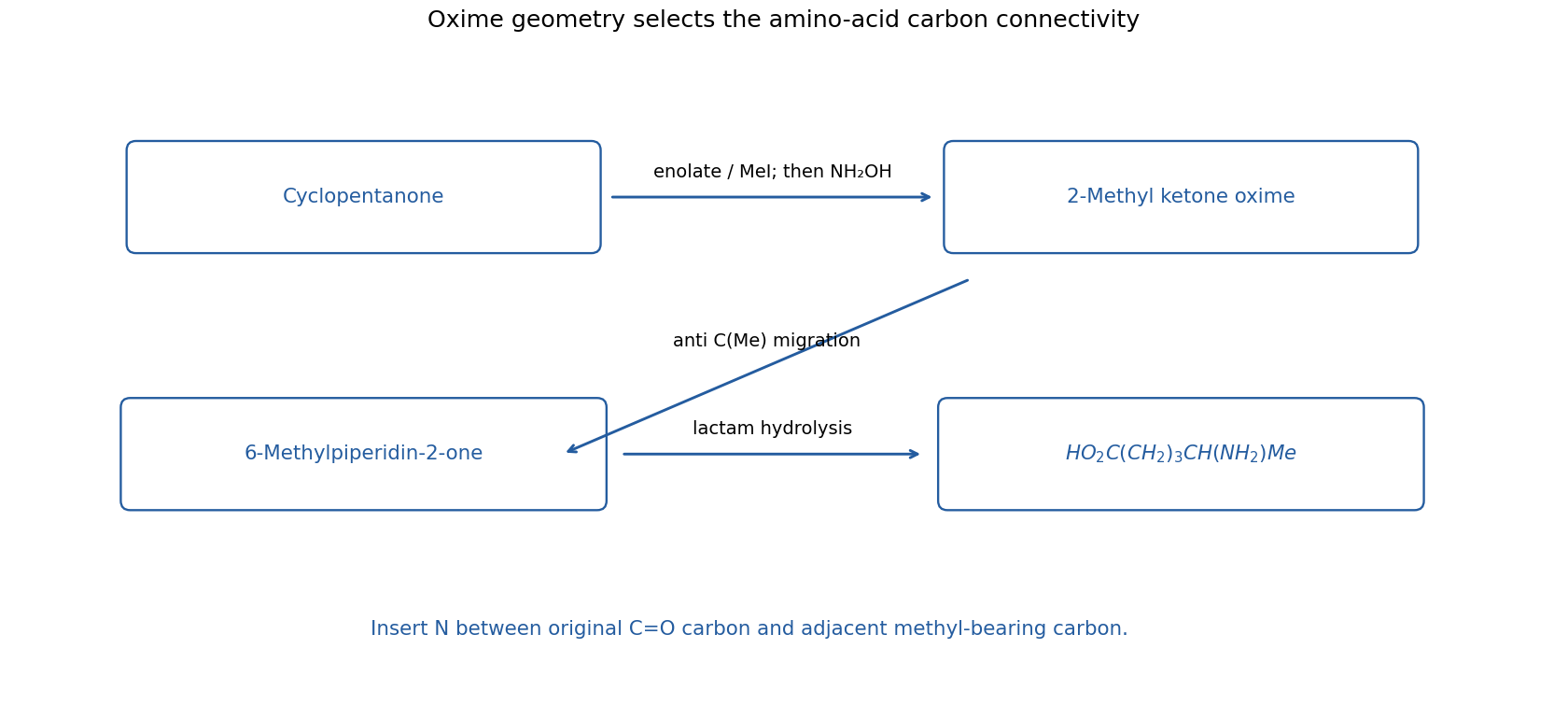
The target is 5-Aminohexanoic acid, . Disconnect its terminal amine/carboxylic-acid relationship through hydrolysis of 6-methylpiperidin-2-one. This six-membered lactam follows from a regioselected Beckmann ring expansion of 2-methylcyclopentanone oxime.
Start with cyclopentanone. Form its enolate with lithium diisopropylamide in dry THF at low temperature, add methyl iodide, then quench to obtain 2-methylcyclopentanone. Control the methyl iodide/base stoichiometry to suppress a second alkylation. React the ketone with hydroxylamine to form its oxime and select the geometrical oxime isomer in which the bond to the methyl-substituted adjacent ring carbon is anti to the departing oxime oxygen group.
Activate the oxime, for example under appropriate acid-promoted Beckmann conditions. The anti methyl-bearing C–C bond migrates onto nitrogen as the N–O-derived leaving group departs, inserting nitrogen between the original carbonyl carbon and the methyl-substituted ring carbon. Hydration/tautomerization gives 6-methylpiperidin-2-one. The opposite oxime geometry would insert nitrogen on the other side and ultimately place methyl at a different position in the amino acid; oxime geometry is therefore an essential part of this proposal.
Hydrolyse the lactam with aqueous acid and heat, then adjust the work-up to the desired acid/ammonium form. Cleavage of its acyl–nitrogen bond opens the ring to after suitable neutralization. All five original cyclopentanone carbons are retained, and the one methyl carbon comes from methyl iodide. A racemic mixture product is appropriate to the stereochemically unspecified target. The reaction sequence is an organic ring-expansion synthesis and requires no biological transformation.

New to topics? Read the docs here!