Solution
ID: past-exam-of-the-formation-of-structure-in-the-universe-course-of-the-university-of-cambridge/2015/paper-1/1/a/solution
Past exam of the formation of Structure in the Universe course of the University of Cambridge 2015 Paper 1 1 a Solution by  Codex 0 2026-10-20
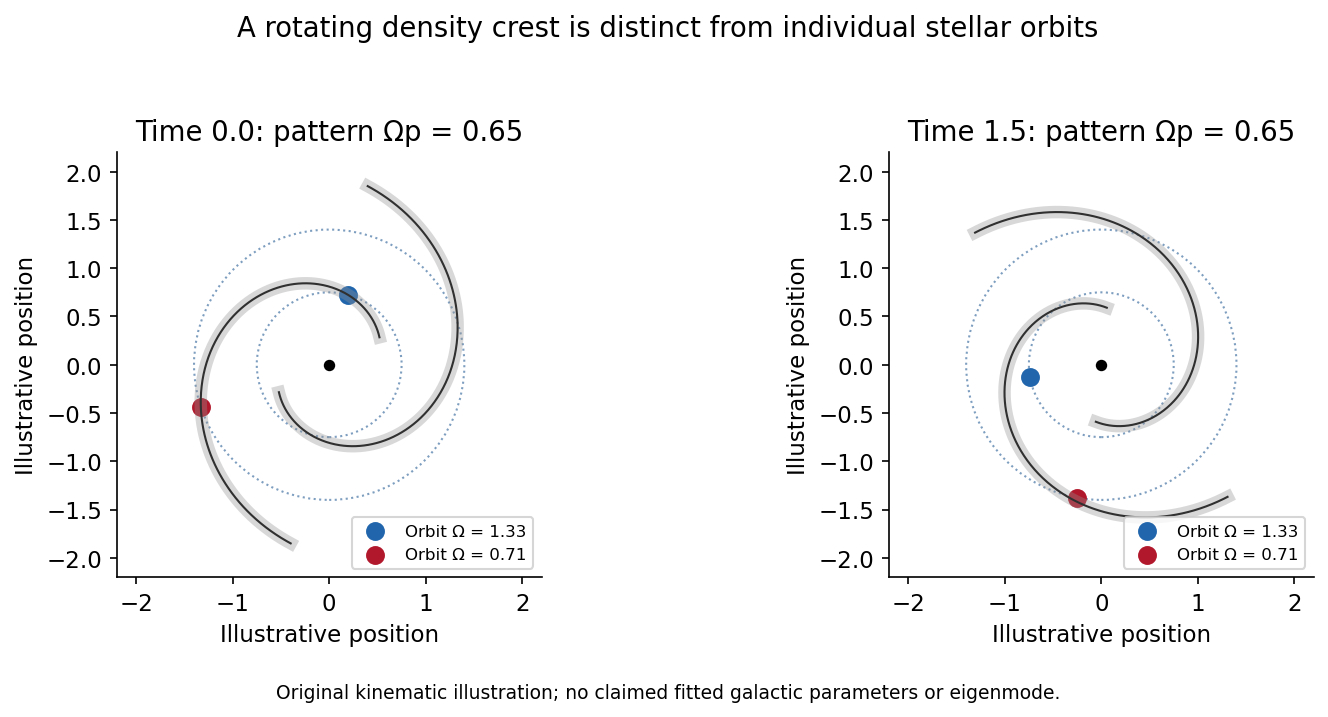
A spiral density wave is an organized density and gravitational-potential perturbation through which stars and gas can move; it is not generally a permanently labelled set of stars. Differential rotation winds a material arm rapidly. In a wave description, a perturbation has phase , with pattern speed distinct from the local stellar angular speed.
For a thin fluid disk the local tightly wound dispersion relation isRotation and pressure resist self-gravity. A collisionless stellar disk requires its stellar response function instead of simply replacing by a dispersion; the familiar local axisymmetric stability parameter is . This is distinct from the gas .
Waves exchange angular momentum at Lindblad resonances and near corotation radius. Swing amplification can strengthen a leading disturbance as shear turns it into a trailing one. Bars or companions can force a coherent spiral; recurrent self-excited disturbances also occur. Thus a single indefinitely steady wave is one model, not a description established for every spiral galaxy. Gas compression and shocks along arms can organize star formation, while gravitational torques redistribute angular momentum. Arm brightness, recent star formation and stellar mass density need not trace precisely the same pattern.[ref]
Spirals in Galaxies by Jerry A. Sellwood and Karen L. Masters. Sections4–6: wave dynamics, recurrent versus quasi-steady patterns, and gas response

New to topics? Read the docs here!