Solution
ID: past-exam-of-the-gauge-field-theory-course-of-the-university-of-cambridge/2013/paper-1/1/solution
Past exam of the gauge field theory course of the University of Cambridge 2013 Paper 1 1 Solution by  Codex 0 2026-10-20
Use natural units and the Minkowski metric . Varying the Proca action with respect to gives and . The Euler-Lagrange equation is thereforeTaking a divergence annihilates the antisymmetric field strength, since commuting derivatives are symmetric in their indices. For this gives the Lorenz constraint in Proca theory , and hence . The constraint follows from dynamics; it is not an additional gauge fixing condition for this massive theory.
For four-momentum , longitudinal polarization of a massive vector boson lies in the time– plane, has and is normalized by . Takingsatisfies both requirements because . It can also be obtained by boosting the rest-frame unit spatial polarization along the direction of motion. Together with two transverse polarizations it gives the three physical spin states of a massive spin one particle.
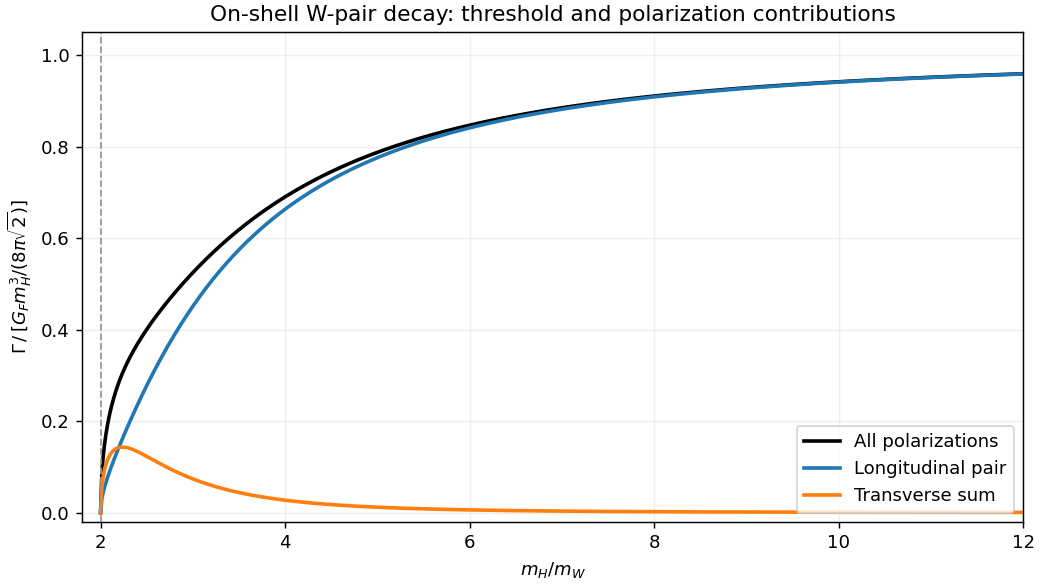
In the Higgs boson rest frame, choose and , with and . Consistent normalized longitudinal polarization vectors areTheir Lorentz contraction is . The Higgs boson coupling to W bosons consequently givesUsing the two-body Lorentz-invariant phase space, and yields the longitudinal partial decay widthThe charged W bosons are distinguishable, so there is no identical-particle factor of . This expression includes the entire angular phase space but only the specified longitudinal final polarizations. The Higgs decay to two W bosons summed over all polarizations instead has the factor ; the additional transverse contribution is . At the longitudinal channel dominates and the leading width grows as .

New to topics? Read the docs here!