Solution
ID: past-exam-of-the-mathematical-methods-i-course-of-the-university-of-oxford/2016/10/solution
Past exam of the mathematical methods I course of the University of Oxford 2016 10 Solution by  Codex 0 2026-10-25
Expanding and equating coefficients gives , . ThusThe two-argument arctangent fixes the quadrant; if , the phase is arbitrary.
For the coupled ordinary differential equations, set . The first equation becomes , and the initial values give . The second then reduces to . Its initial value problem has solutionWhere , reconstruct . The scalar function is smooth for every real , but the original coupled system cannot have a finite at its first zero, about . The requested sketch up to can display the analytic continuation of , with that distinction marked. Initially , and ; it first rises, reaches a maximum, then decreases through zero and becomes negative within the plotted interval.
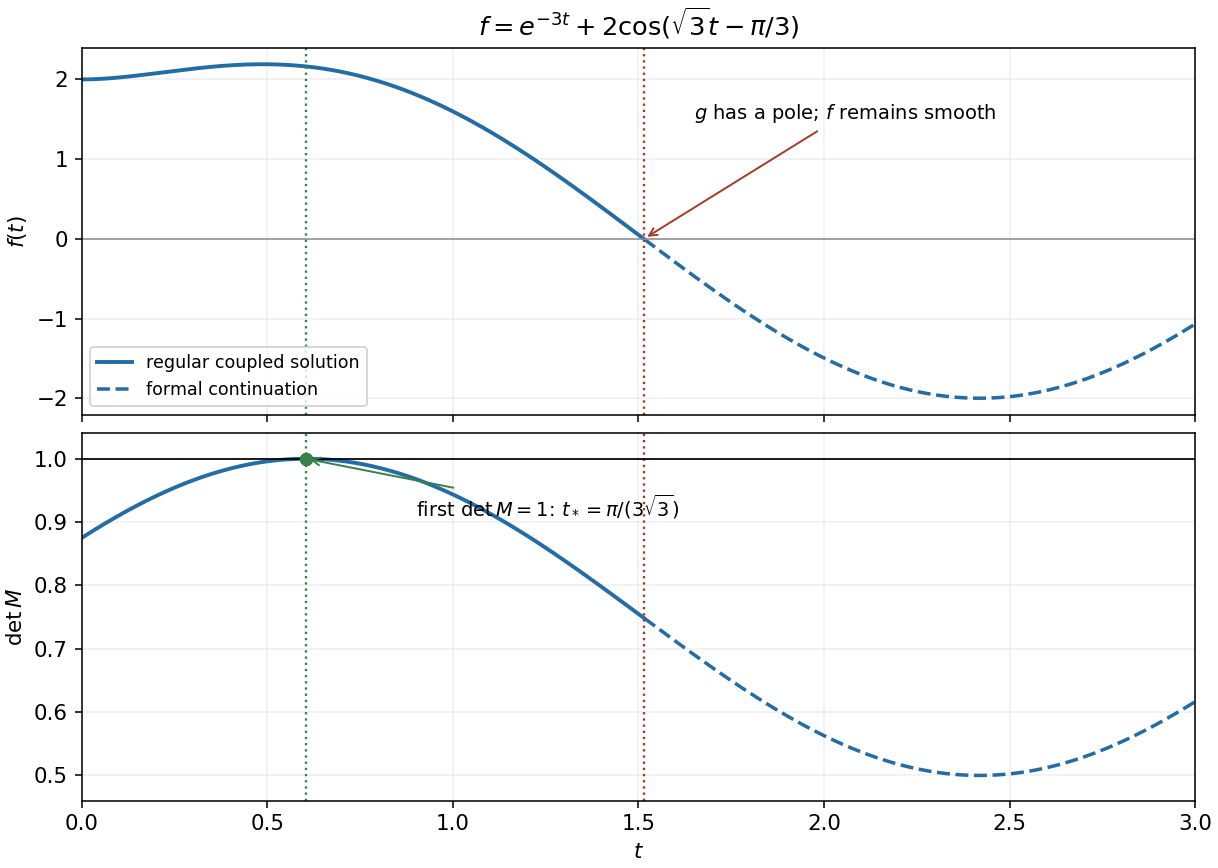
The scalar solution and matrix determinant, with the first regular rotation time and the later pole in the reconstructed variable
. Details. 
For the determinant of , separate its upper-left block from the constant last diagonal entry. Using givesThus precisely when . The smallest positive solution isIt occurs before the zero of , so and are finite there. Put . At this time the upper block isFor a rotation matrix, each column must have unit norm, giving . Both signs are allowed by the stated assumption that is a constant:Both have determinant and preserve lengths. If a positive is intended, only the first row remains; positivity is not stated in the question.
New to topics? Read the docs here!