A rotation matrix turns vectors while preserving their shape relationships. For column coordinate vectors in an orthonormal basis, its defining conditions arewhere is the transpose and the identity matrix. In the usual Cartesian basis of the plane, an active counterclockwise planar rotation through an angle usesHere the vector moves and the basis stays fixed: . Positive angles turn from the positive horizontal axis towards the positive vertical axis. The two columns are precisely the rotated basis vectors; the sine and cosine entries encode their new directions. Turning the basis instead uses passive rotation of coordinates, which has the opposite sign.
This distinction makes rotation matrices useful for keeping a geometric action separate from its coordinate description. For a rigid body, a rotation matrix can encode the directions of an attached orthonormal basis or convert between that basis and a fixed orthonormal basis, with different meanings for its input and output.[ref]
Modern Robotics: Mechanics, Planning, and Control by Kevin M. Lynch and Frank C. Park. Modern Robotics, §3.2.1.2, preprint p. 69: three uses of a rotation matrix
The orthogonal matrix condition preserves every dot product:Consequently Euclidean norms and angles between nonzero vectors are preserved, as is the Euclidean norm of the difference between any two endpoints. The additional determinant condition preserves orientation of a vector space and oriented volume: for any square matrix whose columns are the input vectors, . An orthogonal matrix of determinant , such as a reflection matrix, preserves dot products but reverses orientation of a vector space. The matrix inverse is especially simple: .[ref]
Modern Robotics: Mechanics, Planning, and Control by Kevin M. Lynch and Frank C. Park. Modern Robotics, §3.2.1, definition 3.1 and propositions 3.3–3.6, preprint pp. 67–69
A real rotation matrix is a unitary matrix because it is an orthogonal matrix. It is a Hermitian matrix precisely when it is symmetric, equivalently when its square is the identity. Its eigenvalues are then . In three dimensions a proper rotation is therefore Hermitian only for the identity or a half-turn. A half-turn about a unit vector has matrix : it fixes and reverses the perpendicular plane. For every real rotation , the difference is anti-Hermitian; it is also Hermitian only in the zero case.
Rotate an orthonormal basis counterclockwise by while keeping the vector fixed. The new basis vectors, written in the old basis, are the columns of . The change-of-basis matrix convention therefore givesFor example, the fixed vector with old coordinate vector has new coordinate vector after the basis turns by radians. Its negative second coordinate means that the arrow lies below the new first axis. By contrast, an active planar rotation through that same angle moves the arrow to old coordinates . The sign difference follows from which object moves. The passive component formulas are , .[ref]
Chapter 20: Rotation in space. §20–1, equation (20.3) and the preceding paragraph: the angle relates coordinate axes, not rotating objects
If coordinate vectors are instead written as rows, transposing the active equation gives . Switching to rows changes the side and the transpose; it does not by itself turn an active planar rotation into passive rotation of coordinates.
Apply to a column coordinate vector, then apply in the same fixed basis. The function composition isThus the rightmost matrix acts first. The product is again a rotation matrix, since and . For planar rotations about the same origin, the sine addition formula and cosine addition formula giveFor a concrete composition of rotation matrices, first rotate by radians, reaching , then by radians:The total angle is . Reversing these two planar rotations gives the same answer, but noncommuting rotations about fixed axes show why one cannot assume that property for rotations in three dimensions.[ref]
Use a fixed right-handed Cartesian basis in three dimensions and active rotations in three dimensions through radians. The right-hand rule gives the following rotation matrices about the positive and axes:For the vector , the two orders giveBoth outputs have Euclidean norm , but they point in different directions. Each arrow below is a vector from the origin; the curved paths track its endpoint during each rotation in three dimensions.
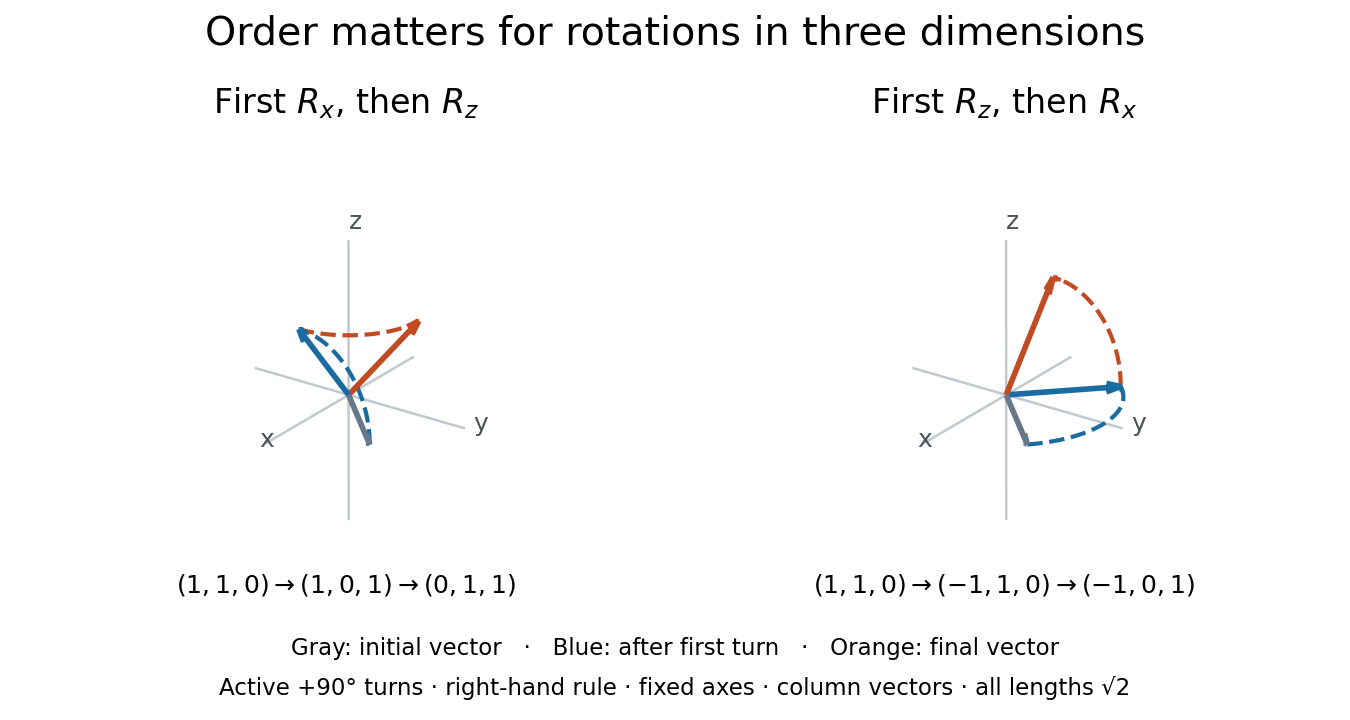
Active rotations in three dimensions about fixed axes: the order changes the final vector
. Details. The axes in this example remain fixed throughout. A command to turn about an object's own current axis describes a different operation because that axis can move after the first turn. With an object's orthonormal basis represented by columns of , a fixed-axis rotation matrix acts by , whereas the corresponding rotation expressed in the object's own basis acts by .[ref]
A proper three-dimensional rotation matrix has an axis eigenvalue one and perpendicular-plane eigenvalues . Their sum gives the displayed trace identity. It determines the angle cosine but does not by itself choose the oriented axis or angle sign.
A planar rotation about the origin is the linear map represented by the rotation matrix . It preserves inner products, lengths, oriented angles and area, with positive angles measured anticlockwise. Its inverse is and its determinant is one.
For column coordinate vectors in the fixed Cartesian basis, an active planar rotation sends to . For radians,The endpoint travels counterclockwise through along a circle of radius . Its Euclidean norm stays . The second Cartesian basis direction becomes , whose dot product with is still zero.
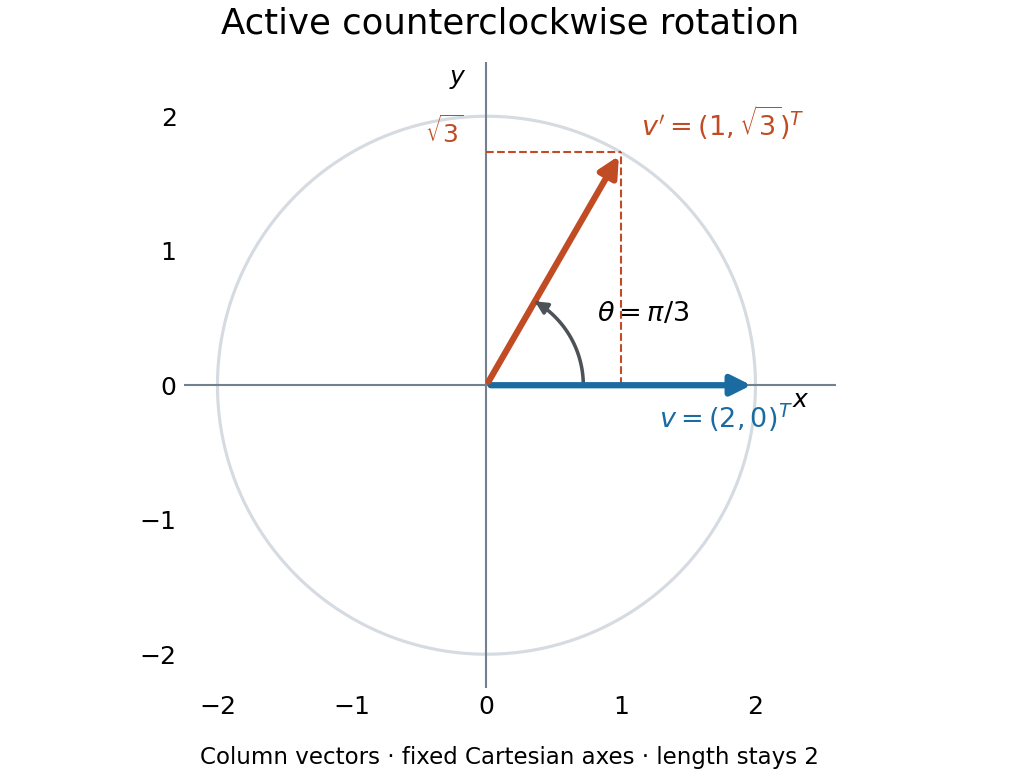
An active counterclockwise planar rotation by : the vector moves while the Cartesian basis stays fixed
. Details. A quick sign check is to look at the first column: must point above the horizontal axis for . The columns have unit Euclidean norm and zero dot product, so ; the determinant is . Finally, the transpose negates the off-diagonal entries, giving : turning back reverses the action. This is the same matrix used for passive rotation of coordinates, though that interpretation keeps the vector fixed.
A finite group of planar rotations about one point is a cyclic group. For a nontrivial group, choose its smallest positive rotation angle . Subtracting multiples of from any other group angle leaves a group angle in , hence zero. Applying the same argument to shows that for a positive integer . The identity-only group is cyclic as well.
For , the real matrix solutions of are preciselyA nonzero such matrix equals , where is a planar rotation matrix with and . It acts like multiplication by the complex number . The zero matrix is the zero scalar multiple of any rotation.
The orientation-preserving rotational symmetry group of a regular icosahedron has order sixty. Its conjugacy classes have sizes : identity; half-turns about opposite-edge axes; rotations through about opposite-face axes; and rotations through and about opposite-vertex axes, respectively. Conjugation carries an axis to its rotated axis and preserves the rotation angle. The transitive group action on edges, faces and vertices gives the indicated classes, with reversal of the axis identifying the two signs. A normal subgroup must contain whole conjugacy classes; none of the proper nonidentity sums of these class sizes is a divisor of sixty. Thus this group is a simple group.
The rotations in three dimensions preserving a dodecahedron form a group of order . There are nonidentity rotations about the six axes through opposite face centres, about the ten axes through opposite vertices, and half-turns about the fifteen axes through opposite edge midpoints. Its nonidentity conjugacy classes have sizes : the centralizer of a rotation of order five or three consists of rotations about its oriented axis and has order five or three, respectively, while all edge half-turns are conjugate. A normal subgroup is a union of whole conjugacy classes containing the identity. No proper nontrivial sum of these class sizes plus one divides , proving that it is a simple group. The centralizers of the fifteen involutions are five distinct Klein four-groups, each containing three involutions. Conjugation permutes these five subgroups nontrivially. The kernel is a normal subgroup, so simplicity makes this nontrivial action injective. Its sign map to a group of order two must be trivial, since simplicity would otherwise force an impossible injection of sixty elements into two. Thus its image lies in the alternating group , and equality of orders makes the image all of .
Articles by others on the same topic



A rotation matrix is a matrix that is used to perform a rotation in Euclidean space. The concept of rotation matrices is prevalent in fields such as computer graphics, robotics, and physics, where it is essential to manipulate the orientation of objects.