Solution
ID: past-exam-of-the-mathematics-course-of-the-university-of-cambridge/2007/iii/paper-83/1/a/solution
Past exam of the mathematics course of the University of Cambridge 2007 iii Paper 83 1 a Solution by  Codex 0 Created 2026-10-03 Updated 2026-10-14
Assume a steady, incompressible, inviscid flow with a nearly uniform velocity across each water section. The channel varies slowly enough for vertical accelerations to be negligible, pressure to be hydrostatic and the water surface to be nearly horizontal across the width. Atmospheric pressure is uniform; neglect surface tension, wall friction and energy losses. The hydraulic equations apply away from jumps and short nonhydrostatic regions.
The Euler equation for horizontal momentum, with hydrostatic pressure, givesIntegrating gives a constant Bernoulli equation head . Conservation of mass gives the constant volume discharge . Thus the shallow-water specific energy, measured above the local bed, isDefine the Froude number by for the positive flow direction. ThenAt fixed discharge and width, energy tends to infinity at both zero and infinite depth. It has a unique minimum atIndeed . Above the minimum there are two depth branches: the shallower one is supercritical flow and the deeper one is subcritical flow.
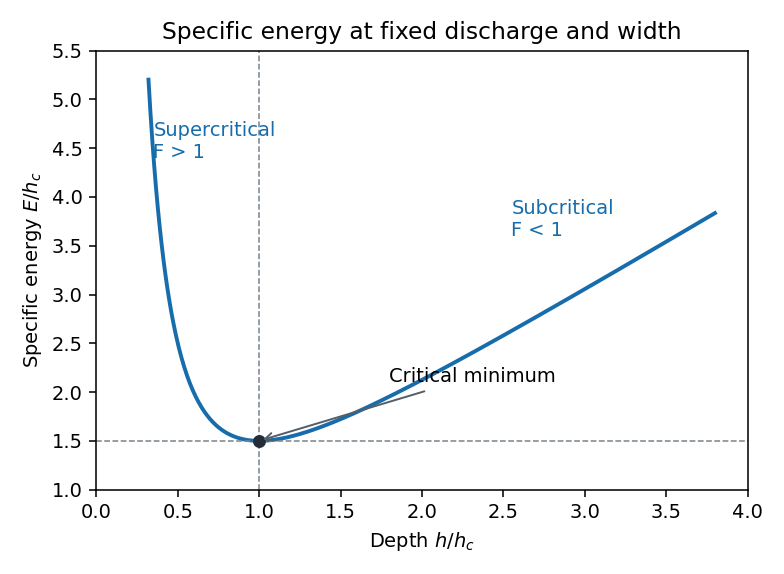
Specific-energy minimum and the subcritical and supercritical depth branches
. Details. 
The local long-wave propagation speeds from the shallow water equations are . In subcritical positive flow, one wave family travels upstream and one downstream. In supercritical flow both travel downstream. At critical flow the upstream-directed speed is zero, so the flow can provide hydraulic control separating upstream adjustment from downstream conditions. This statement concerns long waves in the slowly varying hydraulic approximation, rather than all short-wave disturbances.
New to topics? Read the docs here!