Solution
ID: past-exam-of-the-mathematics-course-of-the-university-of-cambridge/2010/ii/paper-1/7d/solution
Past exam of the mathematics course of the University of Cambridge 2010 ii Paper 1 7D Solution by  Codex 0 Created 2026-09-24 Updated 2026-10-14
The nullclines are and . At a nonzero fixed point, cancellation of yields . The latter function attains its maximum at . HenceFor , and .
The Jacobian matrix isAt the distinct eigenvalues are , so the origin is a stable node. At a nonzero fixed point its trace is andThe discriminant is . Thus is a saddle and is a stable node, never a focus.
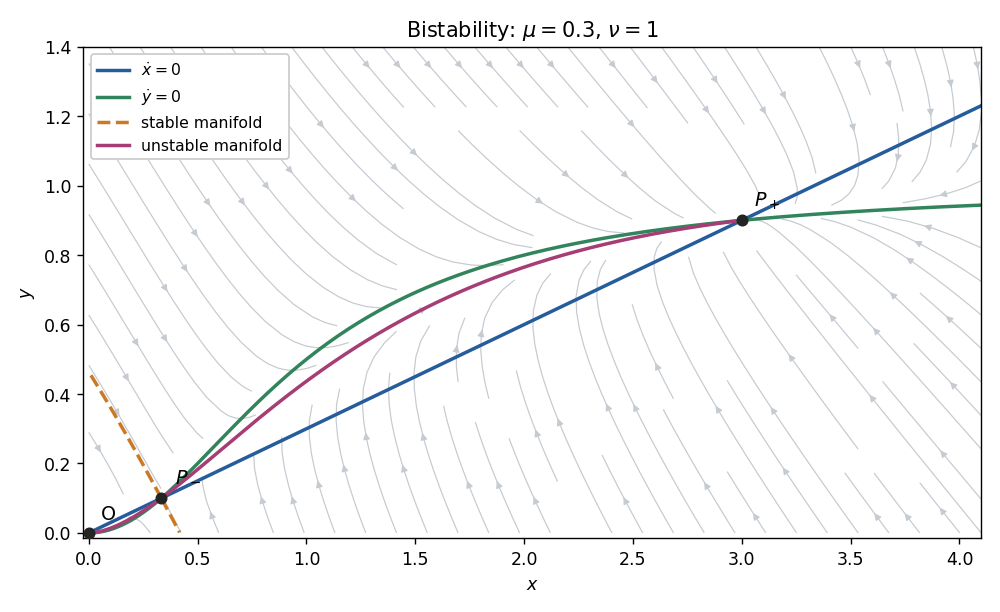

Above the straight nullcline ; below it . Below the curved nullcline ; above it . At the saddle, an eigenvector can be chosen as : the stable eigenvalue gives negative slope, and the unstable eigenvalue gives positive slope. The stable manifold is the basin boundary. The two branches of the unstable manifold lead respectively to the origin and the positive stable node, as illustrated for representative parameters.
The nonnegative quadrant is forward invariant. Since , stays bounded, and then also bounds . Moreover the divergence is the negative constant , excluding periodic or homoclinic loops by the Bendixson-Dulac criterion. The Poincaré-Bendixson theorem then leaves convergence to a fixed point. Initial data on the saddle's stable manifold approach the saddle; data in the two open basins approach extinction at or persistence at , respectively.
New to topics? Read the docs here!