Solution
ID: past-exam-of-the-mathematics-course-of-the-university-of-cambridge/2014/iii/paper-41/3/solution
Past exam of the mathematics course of the University of Cambridge 2014 iii Paper 41 3 Solution by  Codex 0 Created 2026-10-03 Updated 2026-10-14
Codex 0 Created 2026-10-03 Updated 2026-10-14Treat the quarks as the fundamental triplet of approximate flavour symmetry. The flavour product follows by splitting the first two quarks into symmetric and antisymmetric pieces:ThereforeThe dimension check is . The baryon decuplet is the completely symmetric flavour sector, the three-quark flavour singlet is completely antisymmetric, and the two copies of the baryon octet carry mixed permutation symmetry. The two octet copies are a multiplicity space for permutations of the three quark slots, not automatically two distinct ground-state baryon octets.
For the weight diagrams use isospin projection and flavour hypercharge . The quark weights areWeights add in a tensor product. In a three-quark composition, and . The baryon decuplet has rows . Its upper-right weight is , the , while its bottom weight is , the . In the baryon octet, the upper weights are and , giving the proton and neutron. The origin has two independent states with content : the and the . Their equal weights do not make them the same state. The three-quark flavour singlet has only and content , with normalized flavour wavefunctionThis singlet is a different representation from the octet , despite the same quark content and weight.
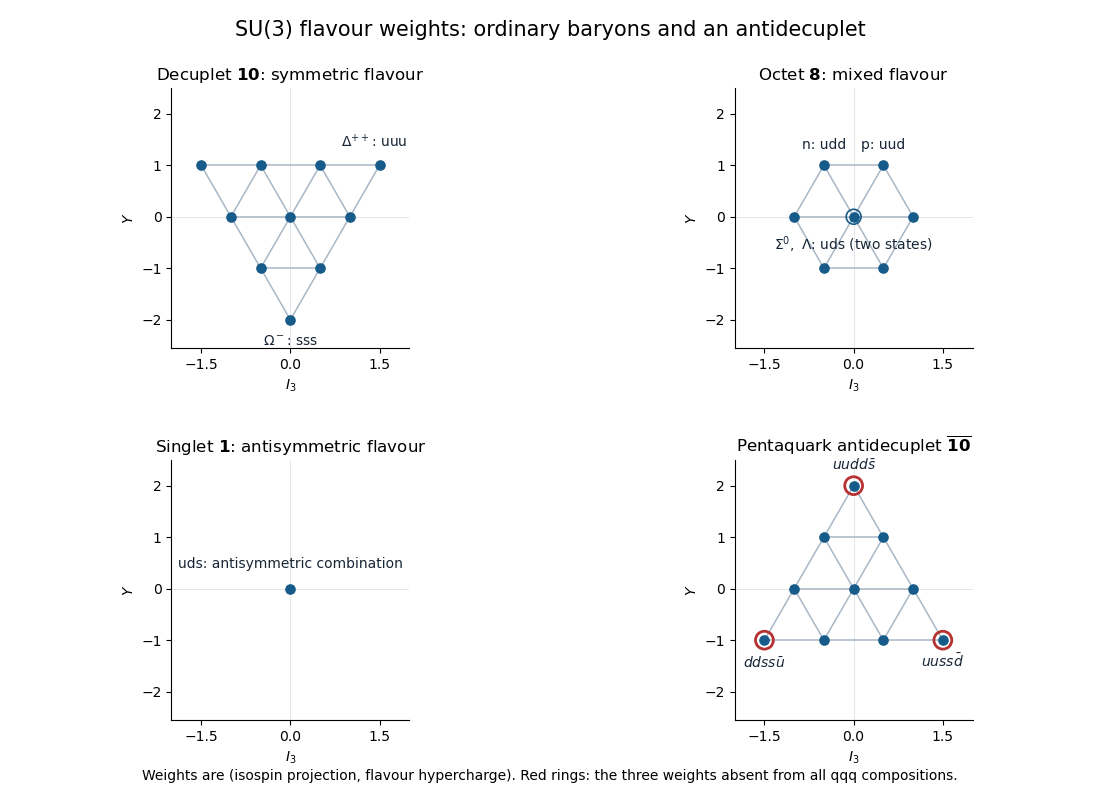
Flavour weight diagrams for the baryon decuplet, octet, singlet and pentaquark antidecuplet; red rings mark the three exotic weights
. Details. 
The Pauli exclusion principle requires the full three-quark wavefunction to change sign under exchange of any two quarks, including their spatial, spin, flavour and colour labels. A three-quark colour singlet has the antisymmetric colour factor . Consequently the remaining spatial-spin-flavour factor must be symmetric. The flavour representation alone is not the full exchange wavefunction.
For the lowest orbital state, the spatial wavefunction is symmetric. Completely symmetric decuplet flavour then requires the symmetric spin- wavefunction; this includes states such as with aligned spins and does not violate Pauli because their colours are antisymmetrized. Mixed octet flavour combines with mixed spin- wavefunctions to give a symmetric spin-flavour factor. More explicitly, the two-dimensional permutation representation of mixed symmetry tensored with itself contains the trivial representation, which selects the physical symmetric combination. These are the familiar ground-state spin assignments.
Antisymmetric singlet flavour in a symmetric orbital state would instead require a completely antisymmetric three-quark spin state. But , so three spin- quarks have no such state. There is no flavour-singlet three-quark ground-state S-wave baryon. A singlet is allowed with orbital excitation: mixed spatial and mixed spin symmetry can combine antisymmetrically, and their product with the antisymmetric flavour sector is symmetric. For example an , spin- configuration can give negative-parity total spins or . This Pauli constraint on three-quark flavour multiplets distinguishes a permitted representation in the flavour tensor product from its possible orbital-spin realization.
For a pentaquark, choose each of two quark pairs in . Their symmetric flavour combination lies in , and combining with the antiquark givesThus contains a pentaquark antidecuplet. This identifies a flavour sector; it does not by itself prove binding or fix the spin and orbital structure needed for overall fermion antisymmetry.
The antidecuplet is the conjugate of the symmetric decuplet, so its rows are . A three-quark state only has , and at it contains two strange quarks and one light quark, allowing only . Hence the exotic weights are preciselyPossible minimal contents are , , and . By the Gell-Mann--Nishijima formula, their charges are respectively . Every other antidecuplet weight is also a weight of some three-quark composition, although its total isospin representation can differ.
Exotic weights do not imply a weak-decay lifetime. The strong interaction can conserve all the quantum numbers in baryon-plus-meson channels, for exampleThese are quark rearrangements into a three-quark baryon and a quark-antiquark meson, not decay into a single three-quark state. Accordingly they are generically short-lived strong resonances if these channels are kinematically open. Flavour representation theory alone gives no masses or widths; a state below all strong thresholds, or one with dynamically suppressed couplings, can be longer-lived. The quantum numbers provide no general protection against the displayed strong decays.
New to topics? Read the docs here!