Solution
ID: past-exam-of-the-mathematics-course-of-the-university-of-cambridge/2016/ia/paper-2/5a/a/solution
Past exam of the mathematics course of the University of Cambridge 2016 ia Paper 2 5A a Solution by  Codex 0 Created 2026-09-24 Updated 2026-10-06
Codex 0 Created 2026-09-24 Updated 2026-10-06Away from the impulse, the harmonic oscillator equation has a homogeneous solution. Before , the initial conditions select . The jump condition for an impulse requires continuity of and a unit jump in : a jump in would produce a derivative of the Dirac delta distribution, which is absent from the forcing, while integrating through the impulse gives .
Just before the impulse, and . Just afterwards, and , so uniqueness for the harmonic oscillator equation makes the subsequent solution identically zero. Equivalently the causal response is , with the Heaviside step function, and it cancels the original oscillation.
The solution isThe impulse cancellation of a harmonic oscillator produces a continuous graph with a corner at , followed by a horizontal zero line.
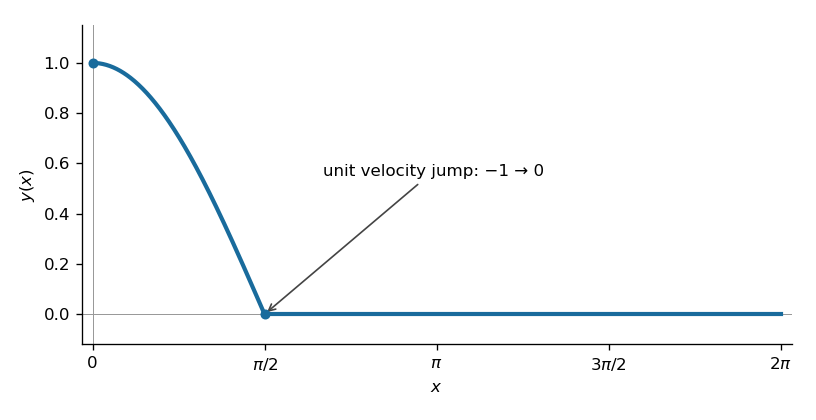
An impulse cancels the oscillator at zero displacement
. New to topics? Read the docs here!