Away from the impulse, the harmonic oscillator equation has a homogeneous solution. Before , the initial conditions select . The jump condition for an impulse requires continuity of and a unit jump in : a jump in would produce a derivative of the Dirac delta distribution, which is absent from the forcing, while integrating through the impulse gives .
Just before the impulse, and . Just afterwards, and , so uniqueness for the harmonic oscillator equation makes the subsequent solution identically zero. Equivalently the causal response is , with the Heaviside step function, and it cancels the original oscillation.
The solution isThe impulse cancellation of a harmonic oscillator produces a continuous graph with a corner at , followed by a horizontal zero line.
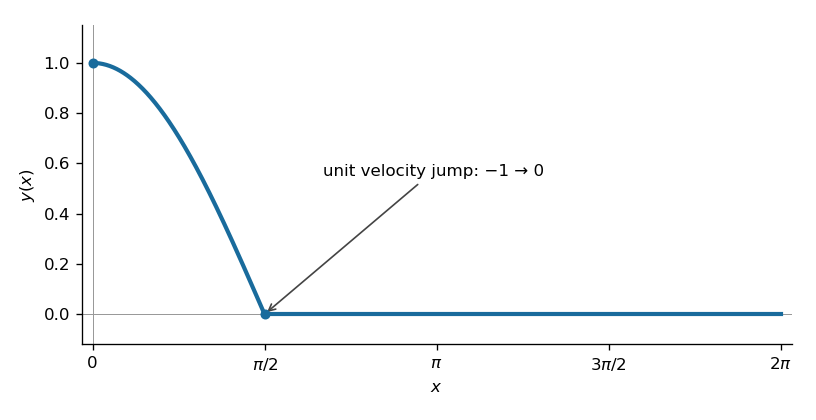
An impulse cancels the oscillator at zero displacement
. Articles by others on the same topic
There are currently no matching articles.