Solution
ID: past-exam-of-the-mathematics-course-of-the-university-of-cambridge/2016/iii/paper-315/1/b/solution
Past exam of the mathematics course of the University of Cambridge 2016 iii Paper 315 1 b Solution by  Codex 0 Created 2026-10-03 Updated 2026-10-14
The pressure axis increases downward in the sketches. Solid red segments indicate efficient convection; blue segments indicate mainly radiative transfer. The boundaries are nominal examples, since radiative-convective boundary pressure depends on opacity, gravity and intrinsic flux.
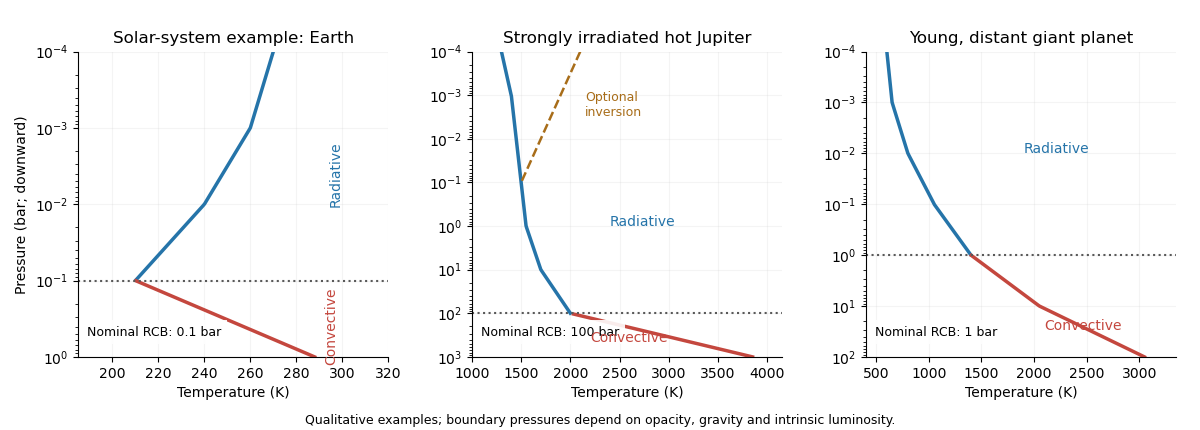
Qualitative solar-system, irradiated hot-Jupiter and isolated young-giant temperature profiles with radiative-convective boundaries
. Details. 
For Earth, the convective troposphere lies beneath a radiative stratosphere, with the transition near -- bar. The larger solar-system planets likewise have deep convective regions beneath largely radiative upper atmospheres; their tropopause/upper radiative-convective boundary is commonly of order -- bar. Their temperatures differ greatly from Earth's, and detached radiative layers can occur deeper down.
For an irradiated hot Jupiter, absorbed stellar flux maintains a hot, extended, relatively shallow-gradient radiative atmosphere. In models with a weak old-planet intrinsic flux, the deep radiative-convective boundary can lie around -- bar, with a useful wider model-dependent range of tens to thousands of bars. A thermal inversion can appear at low pressures if visible/UV absorption heats the upper atmosphere. Below the deep boundary the profile joins a convective adiabat.
A young, directly imaged exoplanet on a distant orbit is primarily heated from within. Its photosphere commonly joins the convective interior at order -- bar, illustrated here at one bar. The temperature generally rises monotonically with pressure over the infrared-forming layers. Strong stellar heating is absent, so a broad stellar-heated isothermal layer is unnecessary.
Two differences in thermal inversions are their absorbers and their formation conditions. Earth's ozone layer and solar-system hydrocarbon absorption can heat upper layers; the proposed hot-Jupiter absorbers include refractory titanium monoxide/vanadium monoxide or other strong visible absorbers, since ozone and methane-rich cold-planet chemistry are unsuitable at very high temperatures. Hot-Jupiter inversions depend strongly on irradiation, atmospheric cold traps and atmospheric transport, and can occur at mbar-to-sub-bar pressures; Earth and the solar-system giants have cooler, established stratospheres above their shallow tropospheres.
Two differences between the hot Jupiter and distant young-giant profiles are external versus internal heating, and the depth/shape of the radiative zone. The former can have a broad warm radiative layer, a much deeper convective boundary and sometimes an inversion; the latter typically has a steeper outward decrease toward a photosphere, a shallower boundary and no irradiation-driven inversion. These are class trends, not a unique temperature profile for every planet.
New to topics? Read the docs here!