Taking the first angular moment of the radiative-transfer equation gives . Radiative equilibrium sets the frequency integral of the right-hand side to zero, so the bolometric flux is constant with depth.
The Planck function is the equilibrium spectral specific intensity of a blackbody, given by Planck's law. Per unit wavelength it isIt can also be written per unit frequency, with under the corresponding change of variable.
The radiation constant relates equilibrium radiation energy density to temperature by . It satisfies in terms of the Stefan-Boltzmann constant.
For the frequency version of Planck law, differentiating gives at its nonzero maximum. Here , so the peak frequency is proportional to temperature. This peak differs from converting the peak of the wavelength version by , because spectral densities transform with a Jacobian.
A blackbody absorbs all incident electromagnetic radiation. In thermal equilibrium it emits the universal Planck law spectrum determined solely by its temperature.
Thermal bremsstrahlung is free-free electromagnetic radiation from the acceleration of charged particles during Coulomb encounters in a thermal plasma. Its frequency-integrated emissivity in a fully ionized, nonrelativistic plasma scales approximately as .
The Gaunt factor is the dimensionless quantum correction to a classical free-free radiation calculation. Its weak temperature and frequency dependence modifies the approximate thermal bremsstrahlung scaling; a frequency-averaged value appears in the bolometric cooling coefficient.
An optically thick medium has optical depth along the relevant path. Photons undergo many interactions before escaping. Radiative diffusion applies under suitable near-isotropy conditions, but a large scattering depth alone does not guarantee thermalization when true absorption is weak.
An optically thin medium has , so attenuation and emission may be expanded to first order in optical depth.
For isotropic emission without significant absorption, integrating the spontaneous photon-production rate along the sightline gives the displayed energy intensity per solid angle. Photon intensity omits the factor . Summing unresolved transitions is necessary before comparing with an observed blended spectral feature.
The absorption coefficient is the fractional reduction of beam intensity per unit path length: when emission and scattering are absent.
A collision or transient molecular pair can possess a dipole even when the isolated molecules do not. The resulting opacity can be important in a dense molecular hydrogen atmosphere. Pair absorption per unit length scales approximately as the product of the two partner number densities, so its mass absorption coefficient is generally density-dependent. It supplies continuum absorption between ordinary spectral lines.
For dust-grain number density and absorption cross-section , the dust optical depth along a path is .
The mass absorption coefficient is absorbing cross-section per unit mass. For identical spherical dust grains of radius , mass , and absorption efficiency , it is .
For isothermal optically thin dust at distance , its measured spectral flux density determines its mass through . Temperature and opacity uncertainty commonly dominate the inferred mass uncertainty.
The radiative transfer source function is emission per unit extinction. If is emission per unit path length and is extinction per unit path length, and the transfer equation is . Under thermal absorption in local thermodynamic equilibrium it is the Planck function; for conservative coherent isotropic scattering it is the mean intensity.
In an optically thick medium whose radiation field is nearly isotropic and thermal, the first angular correction to the Planck function produces the diffusive fluxwhere is the Rosseland mean opacity.
The Rosseland mean opacity is the harmonic frequency average weighted by . It controls radiative diffusion because flux preferentially travels through low-opacity frequencies.
It is a frequency-averaged opacity appropriate to the radiative-diffusion limit, not the general opacity concept itself.
In local thermodynamic equilibrium, matter populations are thermal at the local temperature and the source function is the Planck function, .
Along a radial ray through a layer with constant source function, the incident specific intensity is attenuated by and the layer adds . At small optical depth, . Whether the source exceeds the incident specific intensity determines the first-order emission or absorption contrast.
For a semi-infinite plane-parallel atmosphere with polynomial source function , the outward specific intensity is . Substitution gives coefficients in the surface polynomial in . The deep boundary term must vanish. A local truncated Taylor series instead gives this contribution plus a remainder, so its surface polynomial is not automatically exact.
For a thermalized radiative transfer source function constant along a ray, the specific intensity after optical-depth interval is for . As , it tends to the Planck function, independently of a bounded boundary input. A temperature gradient is unnecessary for blackbody emission. In a scattering medium, local thermodynamic equilibrium alone does not guarantee ; thermalization must be justified.
A non-scattering isothermal atmospheric layer in local thermodynamic equilibrium, of temperature and slant optical depth , lies above a blackbody background at . The specific intensity isThus an increase in opacity shifts the specific intensity toward the layer's Planck function. If a line is more opaque than its continuum, it appears in absorption for , in emission for , and has no contrast for . This is a local explanation, not a claim that all features diagnose one uniform layer.
When the source function varies approximately linearly with optical depth, the emergent intensity obeys .
The relation is an approximation within radiative transfer, not the entire transfer theory.
Coherent isotropic scattering preserves photon frequency and redistributes direction uniformly. Its source function is the mean intensity , so conservative scattering removes light from a pencil beam while preserving luminosity integrated over all escaping directions.
The single-scattering albedo is the fraction of total extinction due to scattering, . Its complement is the absorptive fraction.
Kirchhoff's law of thermal radiation states that a body in thermal equilibrium has equal absorptivity and emissivity at each frequency and direction. A layer with infrared absorptivity therefore emits .
Radiative flux is the first angular moment of specific intensity and measures net radiant power crossing unit area. Integrating over frequency gives bolometric radiative flux. The receiving surface's orientation matters through ; observed radiative flux from a compact distant source conventionally refers to an area perpendicular to its line of sight.
For a steady point-like astronomical source with isotropy of emission, in transparent space with negligible relativistic or cosmological effects, conservation of energy spreads its luminosity over a sphere of surface area . Its bolometric observed radiative flux isThis inverse-square law reflects geometric dilution: the same emitted power crosses increasingly large spheres. It does not require light to lose energy on the journey. For a fixed luminosity, doubling Euclidean distance quarters the observed radiative flux. [ref].
With and parsecs, the result is . At parsecs, the same source gives . An ideal collecting area of at parsecs intercepts approximately , before detector losses.
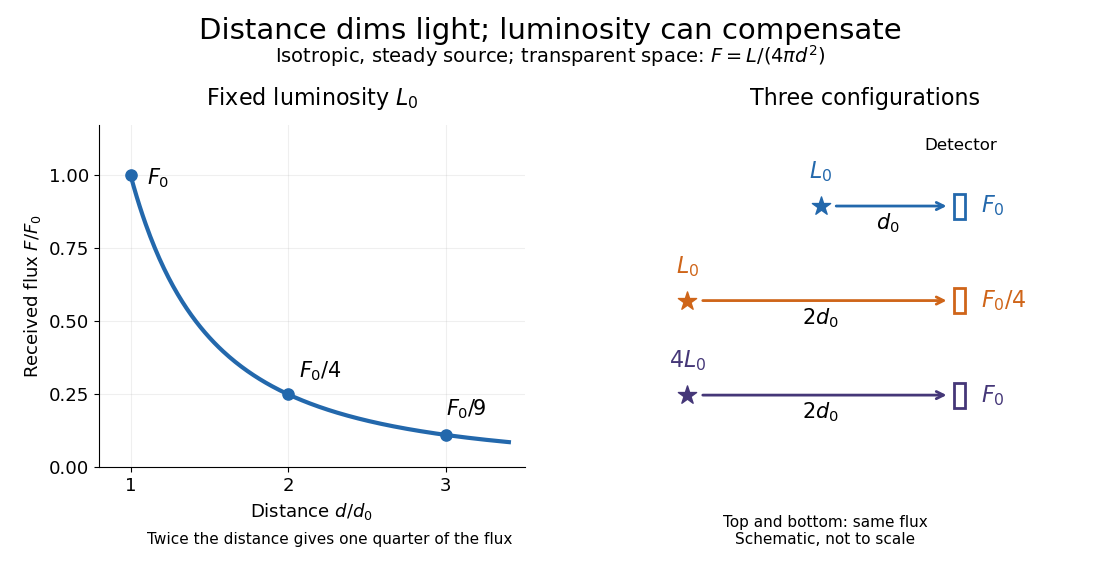
Fixed luminosity gives inverse-square dimming; different luminosities can give equal observed flux; configuration diagram schematic, not to scale
. Details. One observed radiative flux cannot determine both luminosity and Euclidean distance: for every , replacing by leaves unchanged. In particular, at parsecs produces the same observed radiative flux as at parsecs. This is a concrete failure of identifiability in an inverse problem.
An independent stellar parallax fixes the distance and breaks this degeneracy; alternatively, a calibrated standard candle supplies the luminosity. Interstellar extinction can further reduce the observed radiative flux, and a photometric passband measures only a selected spectral range. At cosmological distances, use luminosity distance in the bolometric relation. Each inference must specify which radiative flux was measured and what propagation assumptions connect it to luminosity.
For a uniformly emitting spherical body of radius at Euclidean distance , integration of its specific intensity over the apparent solid angle gives . For a blackbody, and the bolometric result is . A grey emissivity factor multiplies this expression; isothermality alone does not imply blackbody emission.
Spectral flux density is radiant power received per unit area and per unit wavelength or frequency. The two conventions satisfy under , hence when the arguments refer to the same photons. Integrating over a photometric passband gives its measured flux.
The Eddington closure approximation sets the second angular moment to one third of the zeroth, so the radiation pressure and mean intensity satisfy .
For the affine angular ansatz , the radiative flux is . Setting the inward hemispheric flux to zero gives , but then the formal intensity at is negative when . Exact no-incoming radiation and nonnegative intensity cannot both be represented by a nonzero affine polynomial on all directions. The Eddington surface boundary condition therefore specifies approximate moments, rather than an exact emergent angular radiation field.
A grey atmosphere has frequency-independent opacity. In plane-parallel radiative equilibrium under the Eddington closure, its temperature obeys
Consider with real , , and . Its angular mean includes . Substitution into requires . Thus and . For real , only at zero, giving , a contradiction. Independently, its flux contains a varying term proportional to , which is nonzero for nonzero real . Exact conservative transfer therefore needs a more general angular/depth structure than this one smooth exponential correction.
The Hopf function encodes the departure of a plane-parallel grey atmosphere from a purely linear source profile. With physical bolometric radiative flux and standard mean intensity , it is defined by . In thermal radiative equilibrium, . The Eddington closure approximation with its approximate surface condition gives constant ; exact angular transfer generally gives a depth-dependent function.
For no incident radiation and outward intensity approximated as direction independent, the surface angular moments are and . Integrating the radiation momentum equation with the Eddington closure approximation yields the grey atmosphere law . This is an approximate angular boundary condition, not isotropy across both hemispheres.
A plane-parallel atmosphere neglects curvature over its vertical thickness, so thermodynamic variables depend on one Cartesian height coordinate.
A plane-parallel atmosphere is geometrically accurate only if the relevant line-forming region is thin relative to the stellar radius. An isothermal estimate gives . Radiative acceleration reduces the effective gravity and increases extension. A small photospheric does not justify a plane-parallel description of wind lines formed far above that photosphere.
Articles by others on the same topic


Radiative transfer is the process by which energy, in the form of electromagnetic radiation, is transmitted through a medium. This process is governed by the interaction of radiation with matter, which can absorb, emit, and scatter the radiation. Radiative transfer is fundamental in various fields, including astrophysics, climate science, meteorology, remote sensing, and optical engineering.