Solution
ID: past-exam-of-the-mathematics-course-of-the-university-of-cambridge/2016/iii/paper-327/1/solution
Past exam of the mathematics course of the University of Cambridge 2016 iii Paper 327 1 Solution by  Codex 0 Created 2026-10-03 Updated 2026-10-06
Codex 0 Created 2026-10-03 Updated 2026-10-06The test-function space is . Its topology is the strict inductive limit topology of the spaces of smooth functions supported in a fixed compact set , each with the seminorms . In particular, a sequence converges in precisely when its supports lie in one compact set and all its derivatives converge uniformly. The indices use multi-index notation.
The distribution space consists of continuous complex-linear forms on . Equivalently, for every compact there are and an integer such thatWe use distributional convergence: means for every . The pairings are bilinear, with no complex conjugation. A test function is identified with its regular distribution .
For a distribution and a test function , their smoothing convolution with a test function isIt is a smooth function, with . Indeed, for in a compact neighborhood all translated tests have support in one compact set, and their difference quotients converge in the space of test functions. Notice that need not be compactly supported.
Choose a nonnegative mollifier with , and write . If , thenThe right-hand test tends to in : its supports lie in for , and every derivative converges uniformly by the approximate-identity argument. Thus the smooth regularizations converge to as distributions.
To obtain actual compactly supported approximants, choose a smooth cutoff function equal to one on and supported in , and setFor each fixed test function , the cutoff is identically one on its support once is large. Hence . This proves is dense in , and in fact establishes the density of test functions in distributions and gives a convergent approximating sequence for each distribution. The expanding cutoff is essential when has noncompact support of a distribution.
For the radial limit, take a test function and introduce in polar coordinates. The Jacobian givesWhen is supported away from the origin, vanishes near and extends to a compactly supported smooth function on the whole line. The folded sine approximation to a Dirac delta is exposed by setting : integration by parts givesby the Riemann-Lebesgue lemma. ThereforeThis surface delta distribution is arclength measure on the unit circle. By the level-set normalization of a surface delta, it is : the factor two cancels the gradient magnitude on the circle. It is not twice arclength measure.
For a test function that can meet the origin, the endpoint cannot be discarded. Now . Its right derivative is integrable, with from differentiated Taylor expansion: the angular average cancels odd Taylor terms, so near . Applying integration by parts separately on the negative and positive intervals givesThe last two integrals tend to zero by the Riemann-Lebesgue lemma. Thus the radial quadratic oscillation defect in two dimensions gives the stronger oscillating point-mass defect formulaChoose supported in with . Its pairing is , which does not converge. For completeness, if had a limit , the recurrence would force , whereas the even subsequence identity would then force . Consequently there is no limit in .
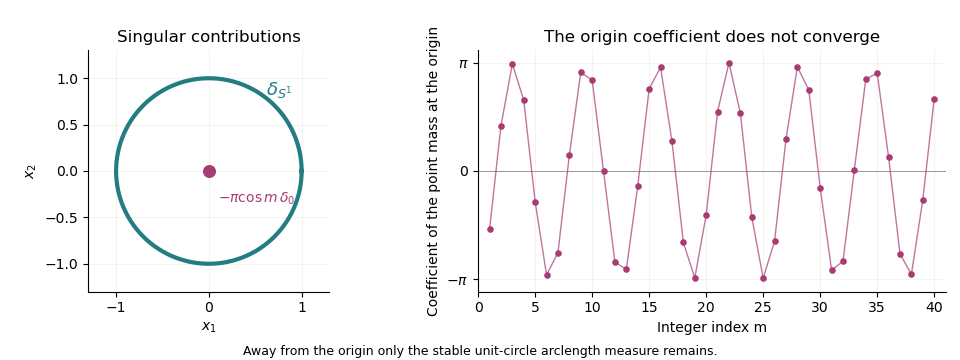
The stable unit-circle arclength contribution and the oscillating point-mass coefficient at the origin
. New to topics? Read the docs here!