A seminorm on a real or complex vector space is a finite-valued function satisfying absolute homogeneity and the triangle inequality:In particular and . A seminorm is a norm exactly when implies : this is the extra definiteness of a norm axiom. The zero function is a valid seminorm. The missing definiteness is useful when a measurement deliberately ignores some directions, such as an individual coordinate or the constant term of a function whose derivative is measured.
For example, on the function is a seminorm that vanishes on every constant function. Adding the value measurement gives the norm : if , the fundamental theorem of calculus gives . A family of such partial measurements defines a seminorm topology.
The kernel of a seminorm is its zero set, a linear subspace by absolute homogeneity and the triangle inequality. The estimate shows that adding an element of does not change . Hence defines a norm on the quotient vector space .
On itself, is a pseudometric; it is a metric exactly when is a norm. In particular, zero distance in one pseudometric need not mean equality of vectors. A separating family of seminorms removes the common zero-distance ambiguity.
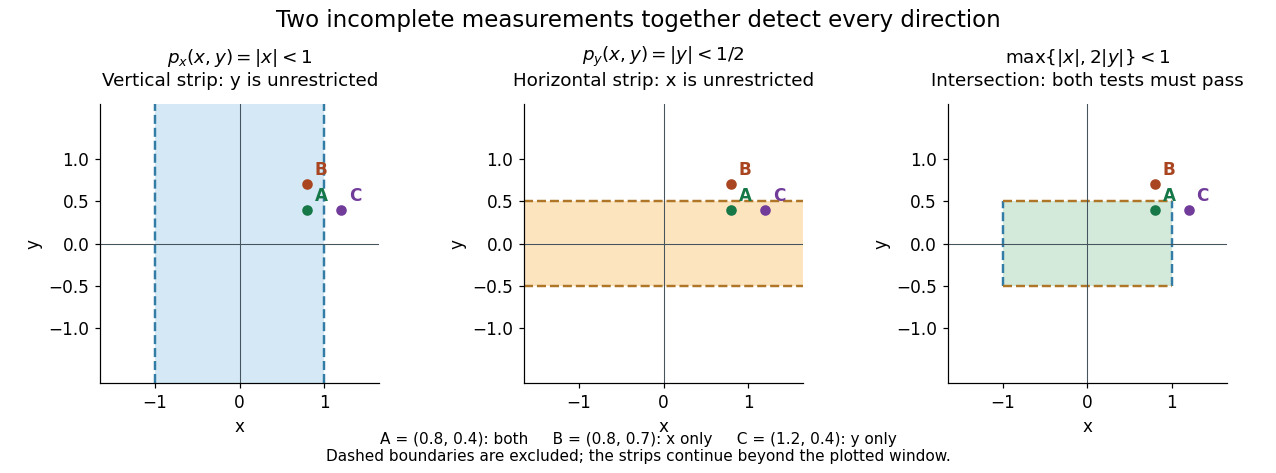
On , the coordinate seminorms and measure horizontal and vertical components separately. Their kernels of seminorms are the vertical and horizontal axes. Neither is a norm, but together they form a separating family of seminorms. A basic zero neighbourhood isEach condition alone is an unbounded strip; their intersection is an open rectangle. For , this is the unit open ball of the maximum norm . For unequal tolerances it is the unit open ball of the weighted norm . Thus the two coordinate measurements generate the usual topology of the plane.
Articles by others on the same topic


A seminorm is a mathematical concept used in functional analysis, particularly in the study of vector spaces. It generalizes the idea of a norm but is less restrictive.