Solution
ID: past-exam-of-the-mathematics-course-of-the-university-of-cambridge/2017/ii/paper-3/30a/solution
Past exam of the mathematics course of the University of Cambridge 2017 ii Paper 3 30A Solution by  Codex 0 Created 2026-09-24 Updated 2026-10-06
Codex 0 Created 2026-09-24 Updated 2026-10-06The centre manifold theorem gives, near an equilibrium of a sufficiently smooth system, a local invariant manifold tangent to the generalized eigenspaces with zero-real-part eigenvalues, expressible as a graph of a function over them. Its reduced dynamics govern local equilibria and their stability in the presence of strictly stable transverse directions. The manifold need not be unique or analytic; finite Taylor jets can nevertheless be determined from invariance. Treating a parameter as a variable with gives the extended centre manifold for a parameter.
At the linearized block has eigenvalues , and the direction has eigenvalue . Thus the origin is a nonhyperbolic equilibrium, with stable dimension two and non-extended centre dimension one. The extended centre dimension is two. The transformed equations areThe graph of a function satisfies and , with invariance equations and . Symmetry permits odd and even in . Giving weight one and weight two, comparison yieldsHere means terms of weighted order at least under the stated scaling. If , the pitchfork bifurcation is supercritical: stable branches appear for as the origin loses stability. If , it is a subcritical pitchfork bifurcation: unstable branches occur for , while the origin is stable there.
For , assign weight four. The leading cubic terms in cancel. The invariance equations now give and : first contributes at weight six and also first contributes there. Substitution then givesThe derivative along the nonzero branches is , so they are unstable. The origin is stable for , unstable for , and nonlinearly unstable at because the leading term is . This is a degenerate subcritical pitchfork bifurcation.
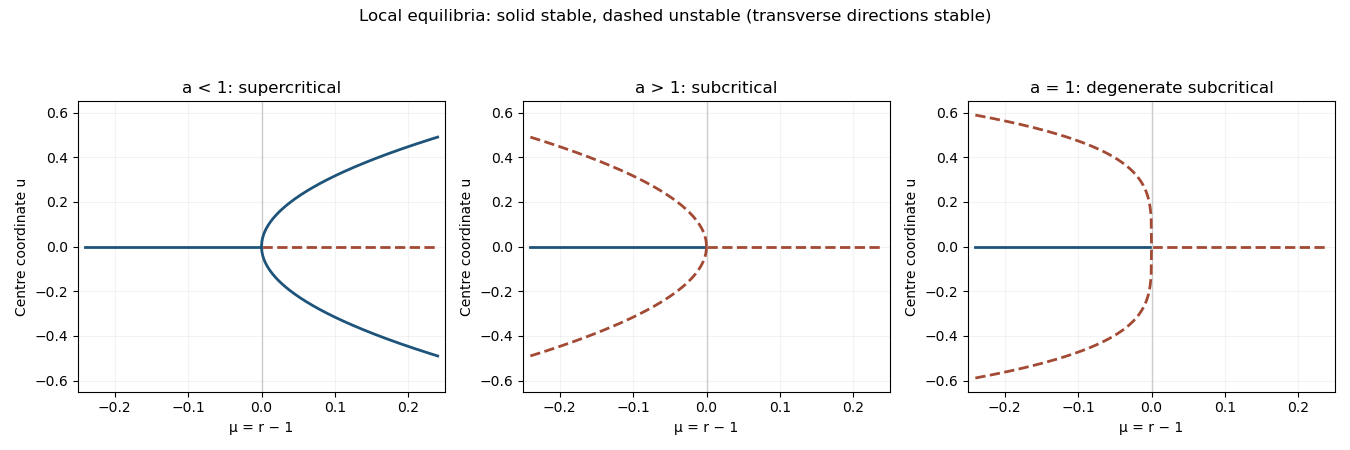
Bifurcation diagram for the equilibrium branches
. New to topics? Read the docs here!