Solution
ID: past-exam-of-the-mathematics-course-of-the-year-1-of-the-natural-sciences-course-of-the-university-of-cambridge/2007/paper-2/section-b/9/solution
Past exam of the mathematics course of the year 1 of the natural sciences course of the University of Cambridge 2007 Paper 2 Section B 9 Solution by  Codex 0 2026-10-20
Set . The gradient of never vanishes, so the Lagrange multiplier equations apply at a constrained stationary point. They are , , and . Eliminating givesWith , this becomes . The quadratic factor is , so the only real possibility is . ThereforeThe level curve through this point is the ellipse , meeting the coordinate axes at and . Its tangent line at has slope , equal to the derivative of the constraint parabola there. The two curves are tangent.
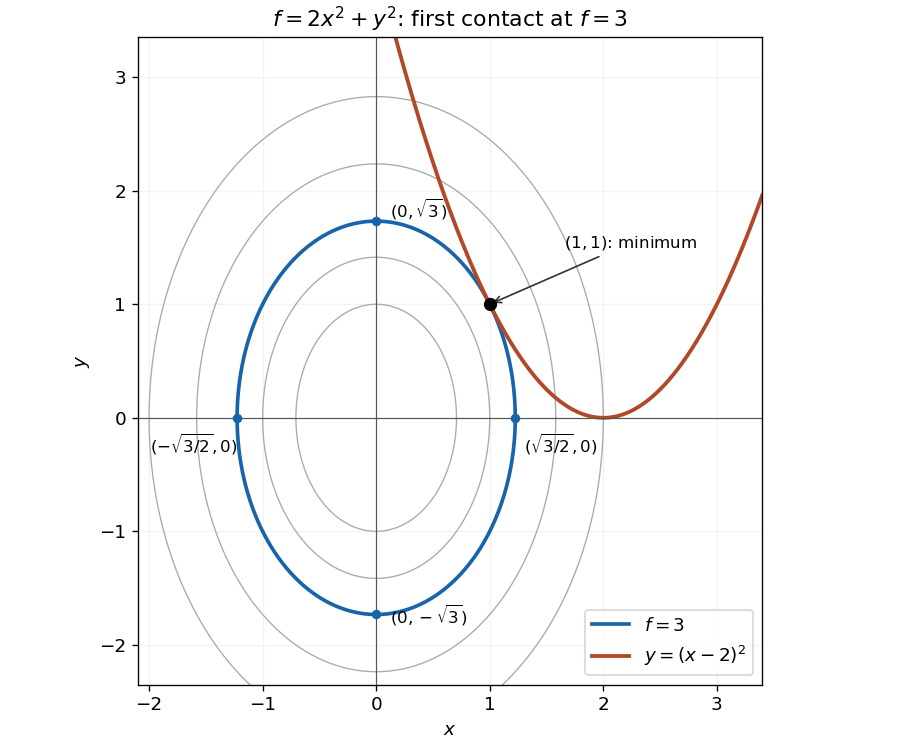
The smallest elliptical contour meeting the constraint is tangent at the minimum
. The highlighted contour is and the constraint is . Its four axis intercepts and the unique contact point are marked. Details.
The parabola touches this ellipse from outside; every other point on the constraint lies on a larger contour. An exact check of this geometric argument iswith equality only at . Thus the point is the unique constrained global minimum.
New to topics? Read the docs here!