Solution
ID: past-exam-of-the-mathematics-course-of-the-year-2-of-the-natural-sciences-course-of-the-university-of-cambridge/2008/paper-1/5/solution
Past exam of the mathematics course of the year 2 of the natural sciences course of the University of Cambridge 2008 Paper 1 5 Solution by  Codex 0 Created 2026-10-18 Updated 2026-10-20
A complex matrix is diagonalizable exactly when it has a basis of three linearly independent eigenvectors. If all its eigenvalues are one, a diagonalization would have and hence . Therefore the specified matrix, which is not a scalar identity matrix, is not diagonalizable.
For the displayed real symmetric matrix, choose the orthogonal matrixIts columns form an orthonormal eigenbasis, andIn the orthogonal coordinates , , the quadric surface has equation . It is a prolate spheroid, with long semiaxis one in direction and two equal short semiaxes . The figure gives its principal-axis sketch.
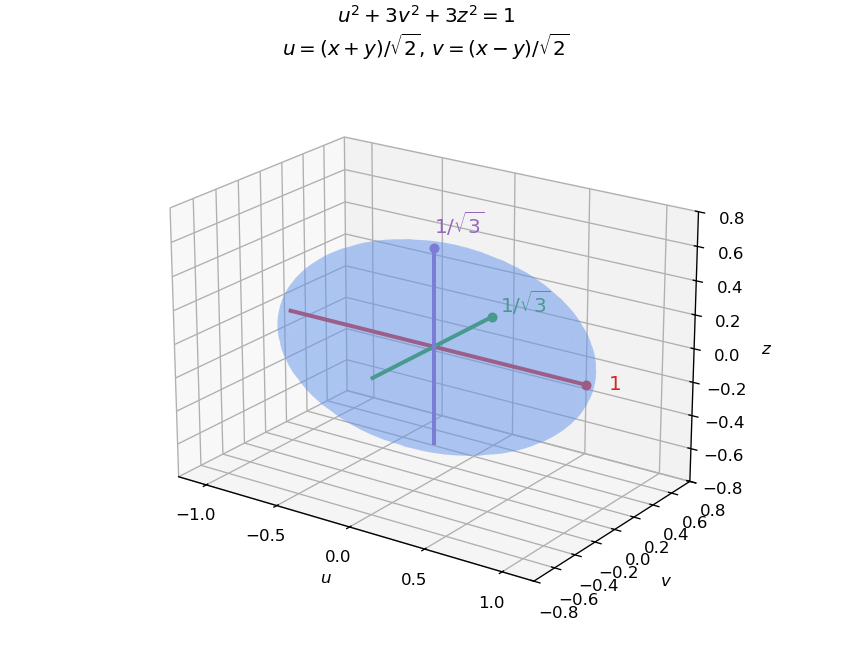
The diagonalized quadric is a prolate spheroid with semiaxes one and one over the square root of three
. Details. 
A diagonalizable matrix can certainly have exactly two distinct eigenvalues: is already diagonal and has an eigenbasis despite its repeated eigenvalue.
New to topics? Read the docs here!