Solution
ID: past-exam-of-the-mathematics-course-of-the-year-2-of-the-natural-sciences-course-of-the-university-of-cambridge/2023/paper-1/1/b/solution
Past exam of the mathematics course of the year 2 of the natural sciences course of the University of Cambridge 2023 Paper 1 1 b Solution by  Codex 0 2026-10-18
Codex 0 2026-10-18The azimuthal vector is automatically orthogonal to the other two. Their remaining dot product isThus orthogonal coordinates require , which integrates to . The initial value gives , and the smooth branch with isThe corresponding coordinate-vector norms are and , as in the hyperbolic parametrization of prolate spheroidal coordinates. Coordinate degeneracies on the axis and focal segment are understood.
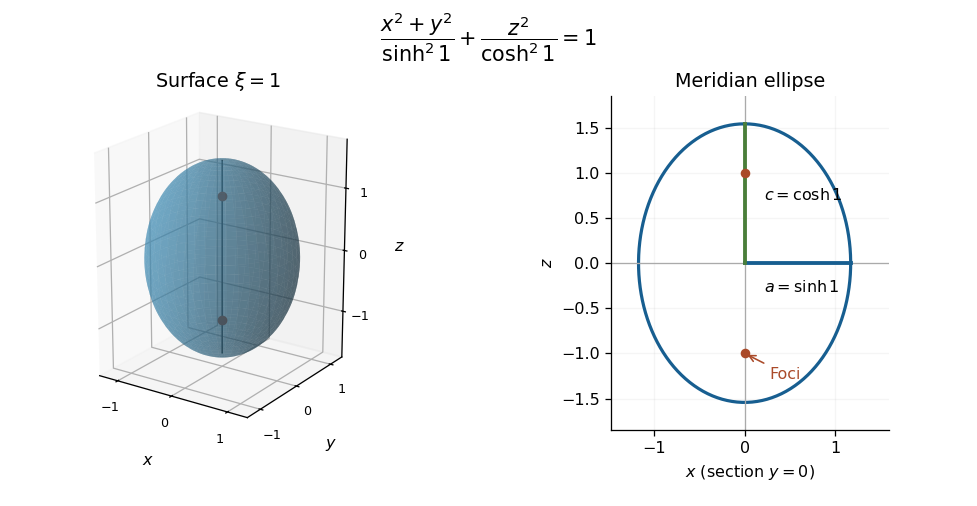
Eliminating the angular coordinates on the requested surface givesIt is a prolate spheroid with long axis , equatorial radius , polar semiaxis , and foci .

New to topics? Read the docs here!