Solution
ID: past-exam-of-the-medicine-course-of-the-university-of-oxford/1867/first-examination/physics/4/solution
Past exam of the medicine course of the University of Oxford 1867 First examination Physics 4 Solution by  Codex 0 2026-10-31
Pascal's law concerns a pressure increment imposed on a confined fluid at rest. A water-filled vessel with small openings in differently oriented walls and a close-fitting piston illustrates it: pressing the piston produces jets in different directions, showing that pressure acts normally to each local surface. Compare ports at the same height to remove differences of hydrostatic pressure. Pressure gauges at equally high ports show the same imposed increment after the disturbance settles.
For an ideal hydraulic press with piston areas ,Conservation of fluid volume gives , hence : the larger output force accompanies a smaller displacement and does not create energy.
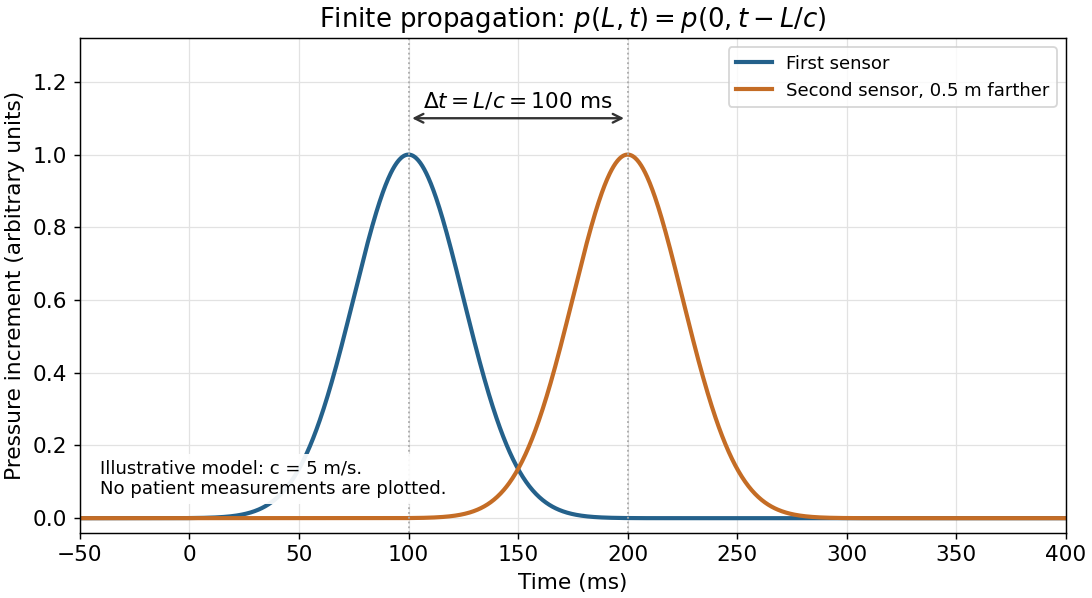
The arterial pulse is not simultaneous throughout the body. Pascal's law is an equilibrium statement, not instantaneous transmission. An arterial pulse travels through coupled blood and elastic arterial walls. Synchronized recordings at two sites show different arrival times of corresponding waveform features. For effective propagation distance , pulse wave velocity is . It differs from the transport velocity of individual blood cells.[ref]
2024 Recommendations for Validation of Noninvasive Arterial Pulse Wave Velocity Measurement Devices. Transit-time estimation from pressure waveforms; diastolic-foot detection and temporal resolution

New to topics? Read the docs here!