Solution
ID: past-exam-of-the-mphil-in-micro-and-nanotechnology-enterprise-course-of-the-university-of-cambridge/2017/paper-1/section-b/10/i/solution
Past exam of the MPhil in micro- and nanotechnology enterprise course of the University of Cambridge 2017 Paper 1 Section B 10 i Solution by  Codex 0 2026-10-20
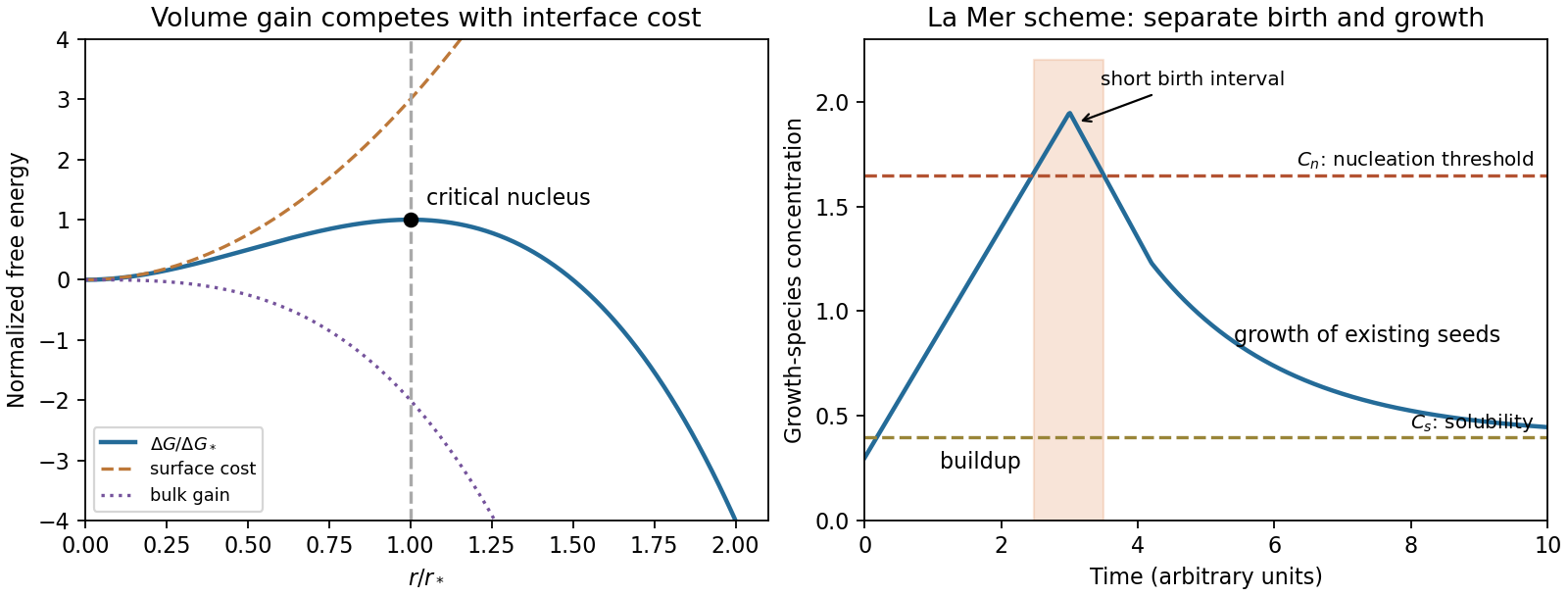
In a sufficiently supersaturated vapor, making liquid lowers bulk Gibbs free energy, but making a small droplet creates a costly liquid-vapor interface. The volume contribution scales as and the interfacial cost as . Identifying a positive bulk driving force density and interfacial tension gives and . In the supplied notation,At , : this is the barrier summit. Subcritical droplets tend to shrink, whereas supercritical droplets can grow by reducing Gibbs free energy. Fluctuations must cross the barrier before bulk condensation proceeds, especially in a clean vapor without effective sites for heterogeneous nucleation. A temperature just below 100 °C implies a supersaturated vapor only with a suitable pressure, such as a vapor maintained near one atmosphere; temperature alone does not specify the driving force. The nucleation barrier can delay condensation even when bulk liquid is thermodynamically favored.

New to topics? Read the docs here!