Solution
ID: past-exam-of-the-optics-and-electrodynamics-course-of-the-university-of-cambridge/2015/paper-1/4/solution
Past exam of the optics and electrodynamics course of the University of Cambridge 2015 Paper 1 4 Solution by  Codex 0 2026-10-20
Polarization under a boost. Lorentz invariance of normalized plane-wave polarization preserves the polarization ellipse's shape, handedness and degree of polarization when its transverse basis is carried to the aberrated ray. The propagation direction changes; equality of a fixed laboratory Cartesian pair of field components is not the appropriate comparison.
Rotate the axes so that a general incident vacuum plane wave has unit direction . Choose the transverse basis , , and arbitrary complex amplitudes . ThenPutting , the given transformation givesThe four-wavevector transforms with Doppler factor , givingIn the corresponding basis , , the transformed field isBoth components of the Jones vector acquire the same positive real multiplier. Their amplitude ratio and relative wave phase are unchanged, proving preservation of arbitrary linear, circular or elliptical polarization. All Stokes parameters scale by , so their normalized values and the degree of polarization are unchanged. An unpolarized light ensemble remains unpolarized under this single-ray boost. A mixture of different ray directions requires separate transformations and is outside this statement.
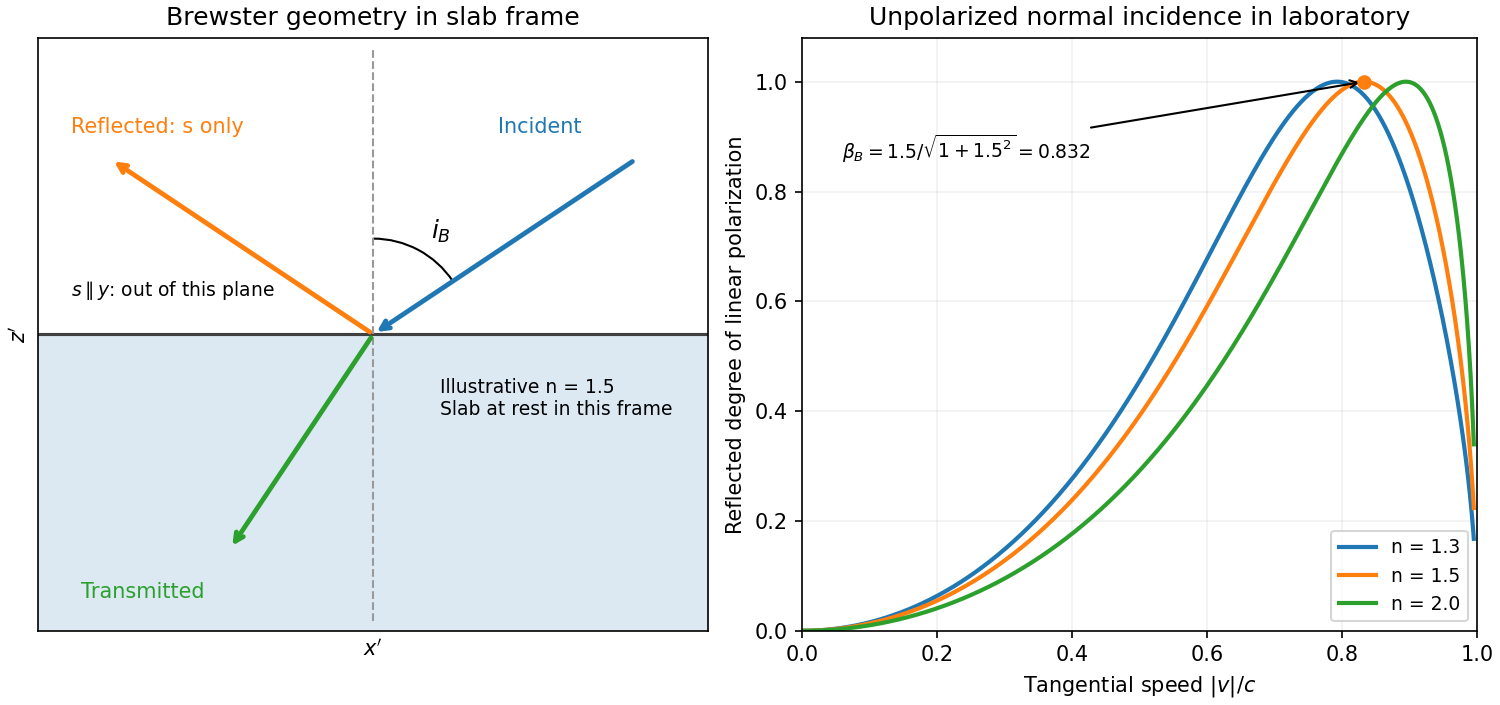
Reflection from the moving slab. Take the upper interface as , the material below it, and the incident ray along . This fixes the sign left implicit by “along the -axis”; choosing the opposite surface convention changes no result below. Treat as the real refractive index in the slab's rest frame, with unit relative magnetic permeability. In the laboratory,Transform to the slab rest frame:The incidence is now oblique, in the plane, at angle to the surface normal:The incoming ensemble remains unpolarized light. In this frame the ordinary stationary-interface Fresnel equations give the amplitude coefficients:For generic oblique incidence, and differ. Equal incident and intensities therefore produce unequal reflected intensities: the reflection is partially polarized. Its degree of linear polarization isThe inverse boost preserves this degree, so the same conclusion holds in the laboratory even though the laboratory incident ray is normal to the surface. The moving material cannot be treated as an isotropic stationary dielectric in that frame.
The reflected rest-frame wavevector is . Boosting back gives : the reflected laboratory ray is normal to the surface and has the incident frequency. There is no contradiction with the oblique rest-frame geometry. Translation tangential to a uniform interface does not itself introduce a moving normal mirror.
Complete linear polarization. For Brewster reflection from a tangentially moving dielectric, at Brewster's angle, and . Combining this with the aberration relation givesOnly the component is reflected. The plane of incidence in the slab frame is , so the reflected electric field is along , perpendicular to the slab velocity. Boosting this field back keeps its electric direction along . For example, the reflected rest-frame field has ; hence and .
This exact extinction assumes a transparent nonmagnetic dielectric with . At the reflected intensities are equal and the reflected beam is unpolarized. If , both reflection coefficients vanish and there is no reflected beam whose polarization can be assigned. With dispersion, evaluate at the shifted frequency ; the Brewster-speed equation is then implicit. absorption generally prevents a real incidence angle from making the complex exactly zero.

New to topics? Read the docs here!