Solution
ID: past-exam-of-the-optics-and-electrodynamics-course-of-the-university-of-cambridge/2017/3/solution
Past exam of the optics and electrodynamics course of the University of Cambridge 2017 3 Solution by  Codex 0 2026-10-18
Codex 0 2026-10-18General pure state. Use time dependence . The most general nonzero Jones vector can be writtenThere are four real parameters in the full complex field. Removing overall intensity and the unobservable common phase leaves two real degrees of freedom for pure polarization, and . Their endpoint degeneracies simply reflect the fact that the phase of a vanishing component is irrelevant. A single Jones vector cannot represent partially polarized light.
Three linear polarizers. Define the transmission axis . An ideal linear polarizer has Jones matrix . For definiteness label as right-circular in the chosen convention; reversing the handedness convention changes no intensity below. The first polarizer produces . The intermediate polarizer and final analyzer then giveso Malus's law givesThe maximum is at , and the transmission vanishes at . The first polarizer accounts for an initial factor ; retaining that factor is essential when quoting transmission relative to the incident circularly polarized beam.
Waveplate and quarter-wave matrix. A lossless waveplate has linear birefringence: its orthogonal fast and slow axes have indices . A thickness produces slow-minus-fast phase retardationResolving the incident Jones vector into the plate axes, advancing the two phases and transforming back gives, up to a common phase,A quarter-wave plate has modulo . With and , its Jones matrix is thereforeIn particular . Equal incident components along the two axes acquire a relative quarter-cycle phase, converting linear polarization to circular polarization; an incident component along either principal axis stays linearly polarized.
Half-wave replacement. A half-wave plate has and henceIt converts the -polarized output of the first polarizer to a linear state at angle . The final analyzer givesThe maximum is , because the ideal half-wave plate loses no light after the first polarizer.
Quarter-wave replacement. The transmitted amplitude is , givingMore generally, the retarder gives . All three requested curves have the same zeros and angular period, but different heights:
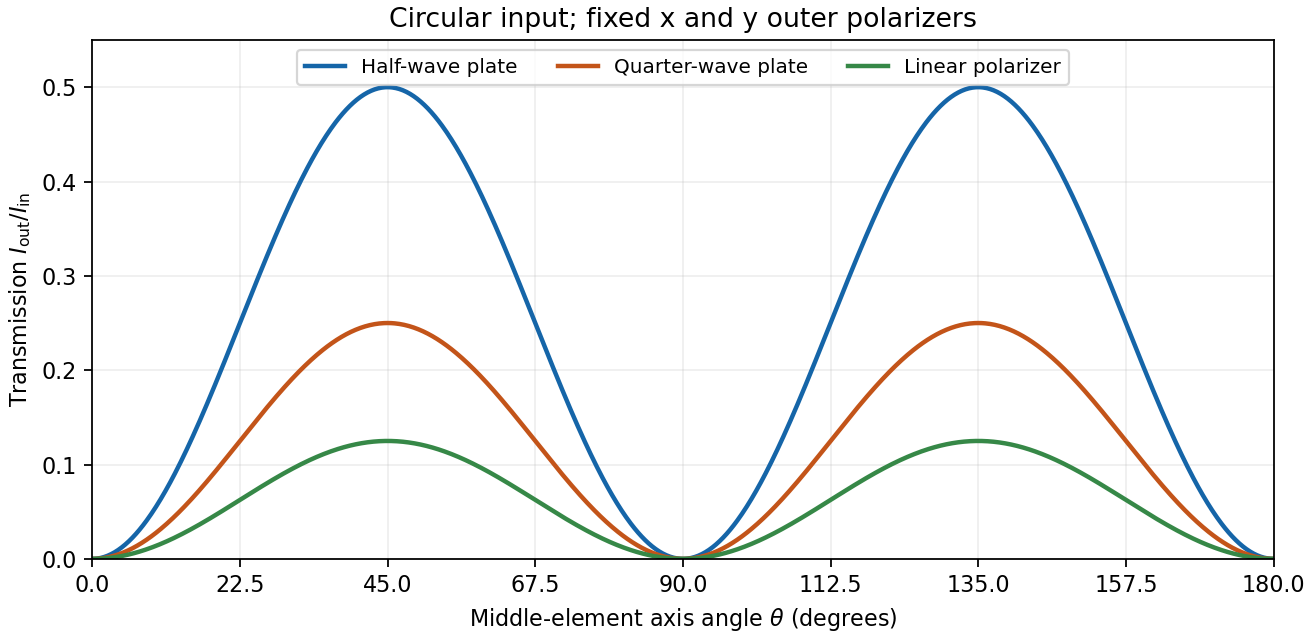
Transmission through crossed outer polarizers with three different middle elements
. Details. 
Preparing an arbitrary ellipse. Yes: two rotatable quarter-wave plates already suffice. Let the input left-circular state be . Up to an overall phase, any target pure polarization can be parameterized by its polarization ellipse:Here is the major-axis orientation, and sets the signed minor-to-major semiaxis ratio . First note directly from thatChoose the two fast-axis angles asThe first quarter-wave plate produces linear light at . In the axes of the second, its components are ; the second gives precisely . This proves pure-polarization preparation with two quarter-wave plates, including the linear and circular limiting cases. A half-wave plate can also rotate the axes, but is not required. The phrase about left-handed input is understood as left-circular light in this construction; the explicit vector fixes the convention.
Switchable retardation. The electro-optic Kerr effect induces linear birefringence quadratic in a static transverse electric field. Defining the coefficient by , its phase retardation isThe two eigenpolarizations are linear, parallel and perpendicular to the applied field. Thus an appropriate field produces a switchable quarter-wave plate:The sign of determines which axis is fast. Switching the field off removes the induced retardation, assuming no residual birefringence.
The Faraday effect instead gives circular birefringence for a longitudinal magnetic field. The two circular eigenmodes acquire different phases, rotating a linear polarization throughwith sign set by the handedness convention and the Verdet constant . Its Jones matrix in the linear basis is a real rotation, up to a common phase. It preserves the ellipticity of a pure state, so a linear input remains linear. A phase difference between circular eigenmodes rotates a linear state by ; it does not make it circular. The Kerr device supplies the switchable quarter-wave plate; a Faraday rotator alone does not.
New to topics? Read the docs here!