Solution
ID: past-exam-of-the-options-ii-course-of-the-university-of-oxford/2005/f/2/solution
Past exam of the options II course of the University of Oxford 2005 F 2 Solution by  Codex 0 2026-10-31
A sufficient regular-level condition is at every point with . The implicit function theorem then makes the zero level a two-dimensional continuously differentiable submanifold. Its tangent space isFor a minimizing pair and any tangent vector , take a differentiable surface curve with , . The function has a minimum at zero, so its derivative vanishes. Varying the other point similarly proves orthogonality to .
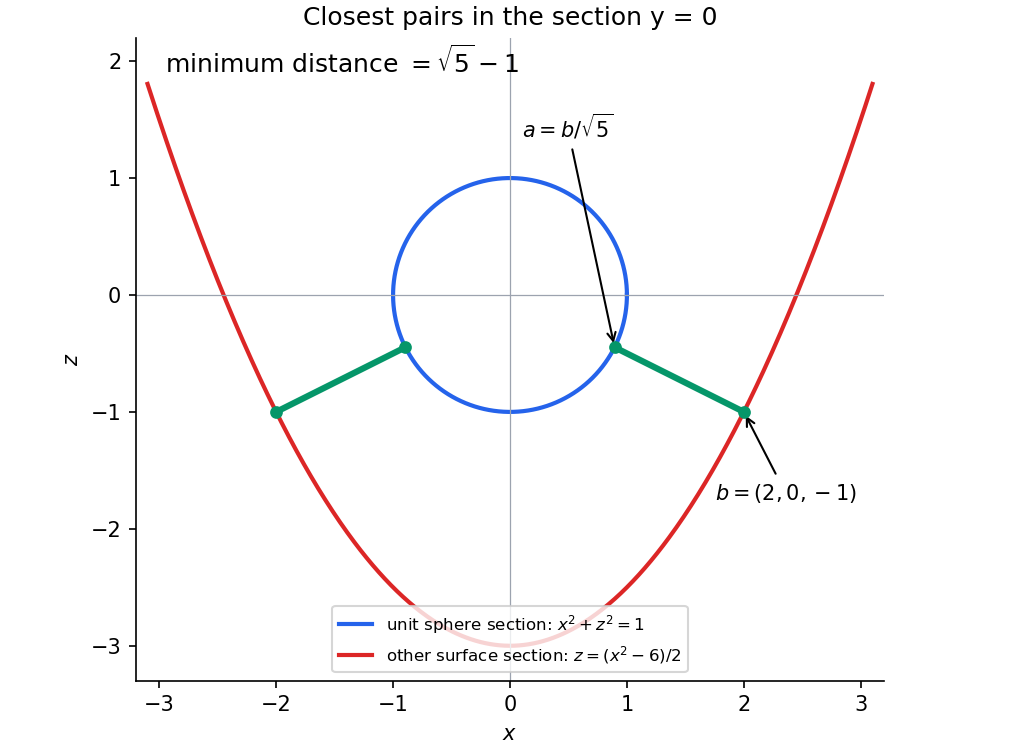
For the particular surfaces, minimize the distance from the origin to the second surface first. Put , , so and . ThenLet . Since , this is at least , with equality when one of is zero. For , this quadratic has its minimum at , with value 5. For , it decreases up to zero and has minimum9 on that half-line. The global minimum is therefore5, attained atAll points of this surface lie outside the unit sphere. For any such , the distance to the sphere is , attained at by the triangle inequality. ConsequentlyThis is a global minimization, not merely a stationary-point calculation.

New to topics? Read the docs here!