An equation can define a function without giving an explicit formula for it. The implicit function theorem tells us when the constraint determines uniquely from nearby , and makes the resulting function continuously differentiable. It is useful when solving an equation explicitly is cumbersome or impossible: the partial derivatives already reveal whether local recovery is possible.
Let be a continuously differentiable map from an open subset of to . Suppose and the partial derivative is an invertible linear map. There are open neighbourhoods of and of and a unique continuously differentiable function such that, for ,Thus the nearby level set is a graph of a function. The derivative of this graph isThe matrix inverse acts on the left; the order matters in several dimensions.
For example, take the unit circle, written as the level set . At , , so the local upper branch is . Implicit differentiation givesThis tangent line slope is available directly from the constraint. The negative square root branch is elsewhere on the same circle; it does not destroy uniqueness near the selected upper point.
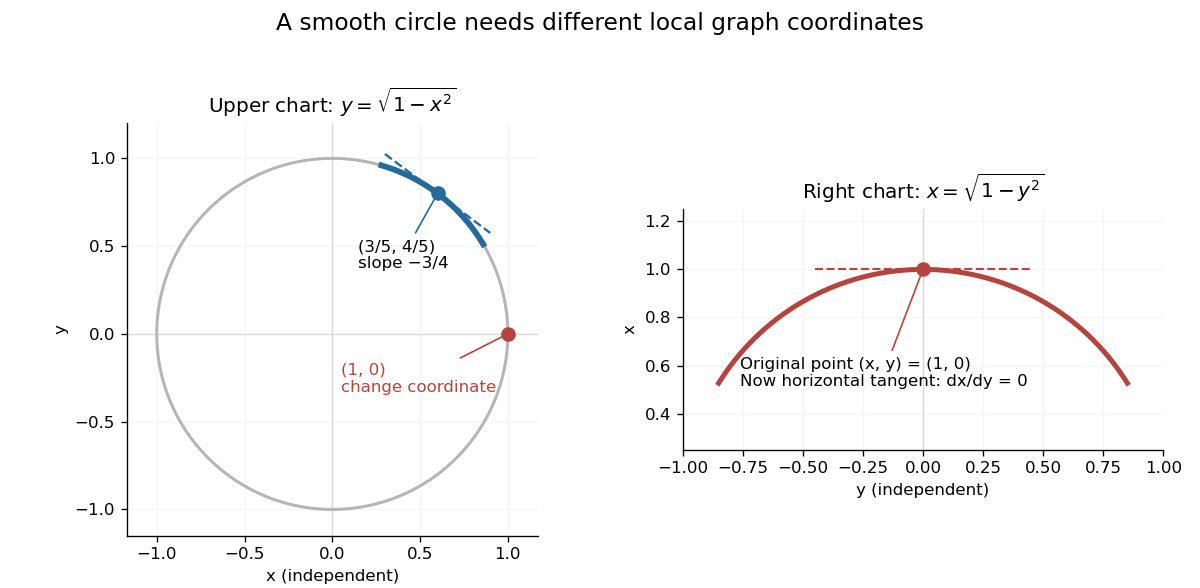
The same circle uses y as a function of x near its upper arc and x as a function of y near its rightmost point
. Details. At , however, and the circle cannot be represented locally as one function : just to the left of there are two nearby values of . The circle is still smooth there. Since , use the other coordinate instead: , with . A failed coordinate choice is different from a geometric singularity.
The derivative condition is sufficient, not necessary for every possible implicit graph. For , the entire zero set is the smooth graph , even though vanishes there. In this case the defining equation itself has a degenerate derivative; the theorem's test gives no conclusion.
The connection to the inverse function theorem is particularly elegant. Augment the constraint to the map , whose Jacobian matrix isIts determinant is . When this is nonzero, locally invert and set its second output to zero. The recovered second input is . In this way an implicit constraint becomes an ordinary inverse function problem. [ref]
https://www.math.utoronto.ca/courses/mat237y1/20199/notes/Chapter3/S3.3.html. University of Toronto MAT237: the implicit theorem as a corollary of the inverse theorem
For two constraints , the implicit function theorem gives differentiable functions when the Jacobian determinant is nonzero. At its zeros this particular projection can fail even when a geometric curve remains. A nonzero tangent vector with zero component gives a vertical tangent in that projection. Singular constraint representations require further care: a determinant of zero alone does not prove an infinite derivative or even a regular intersection.
If a holomorphic function satisfies and , then near its zero set is the graph of a unique holomorphic function. The analogous statement with uses as the local coordinate.
Implicit differentiation differentiates an identity along a differentiable branch and uses the chain rule to solve for its derivative:The partial derivatives treat as independent coordinates before evaluating on the branch. The implicit function theorem justifies the branch's local existence and regularity under its hypotheses; differentiating alone does not establish either. For the unit circle at , this calculation yields the tangent line .
On a regular level set , holding fixed gives . If is continuously differentiable and both and are nonzero, the implicit function theorem gives and . Multiplication proves the identity. The same held-fixed variable is essential, and a zero denominator invalidates the corresponding quotient rather than creating an infinite factor that may be cancelled formally.
On a level set , implicit differentiation gives the three ratios , and . Their product is wherever all the required coordinate representations are differentiable with nonzero denominators. At coordinate singularities the quotient product need not be defined.
Articles by others on the same topic


The Implicit Function Theorem is a fundamental result in calculus and differential topology that provides conditions under which a relation defines a function implicitly.