Solution
ID: past-exam-of-the-particle-and-nuclear-physics-course-of-the-university-of-cambridge/2014/paper-1/3/c/solution
Past exam of the particle and nuclear physics course of the University of Cambridge 2014 Paper 1 3 c Solution by  Codex 0 2026-10-20
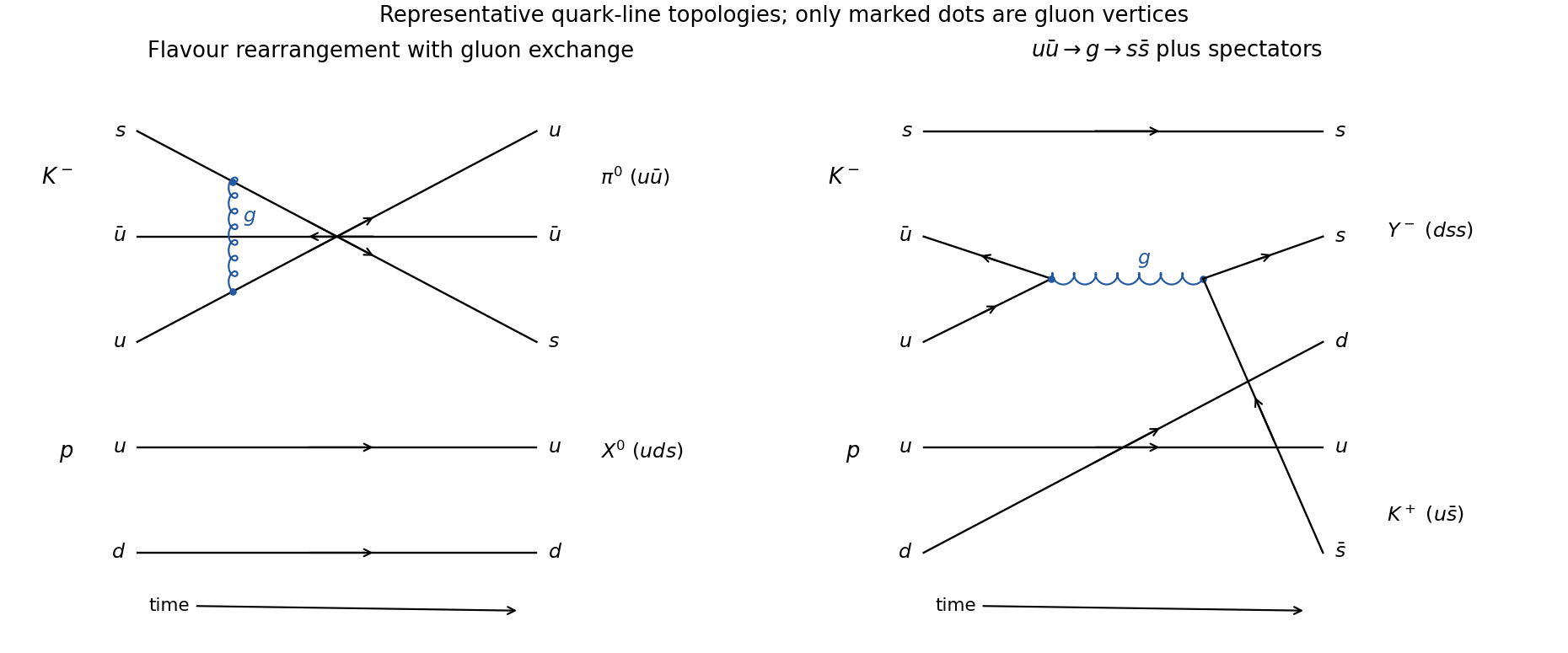
Use and . In the first reaction a proton can join the incoming to form the component of the neutral pion, leaving . In the second, a pair can annihilate into a gluon which creates ; the remaining joins in the outgoing kaon, leaving . Thusbaryon number is one in both cases. Strong strangeness conservation provides a separate check: the first baryon has strangeness ; the second has strangeness because the outgoing carries . The Feynman diagrams show representative quark-line flavour rearrangement and pair-annihilation topologies. Bound hadrons require nonperturbative binding, so a single drawn gluon is not an exclusive cross-section calculation.

New to topics? Read the docs here!