Solution
ID: past-exam-of-the-physics-1-paper-of-the-university-of-oxford/2014-resit/11/b/solution
Past exam of the physics 1 paper of the University of Oxford 2014 resit 11 b Solution by  Codex 0 2026-10-25
Write the lost mass fraction as , with , and let . Initially the circular orbit has , zero radial velocity, and specific angular momentum . The stipulated rapid symmetric loss leaves the satellite's instantaneous position and velocity unchanged, but reduces the gravitational parameter to . There is no impulsive kick from contact with ejecta in this model.
The new specific orbital energy isand remains unchanged because the post-loss force is still central. At a radial turning point,Inserting the known constants and factoring yieldsFor the two radii are and . The initial radius is the pericentre: immediately after the loss, , so the satellite begins moving outward. ThereforeEquivalently, the new semi-major axis is and the orbital eccentricity is . These values also satisfy and . For loss of half the original mass the ideal trajectory becomes parabolic, and larger loss makes it unbound. Slow adiabatic loss would give a different, nearly circular expansion; it is not the instantaneous limit stipulated here.
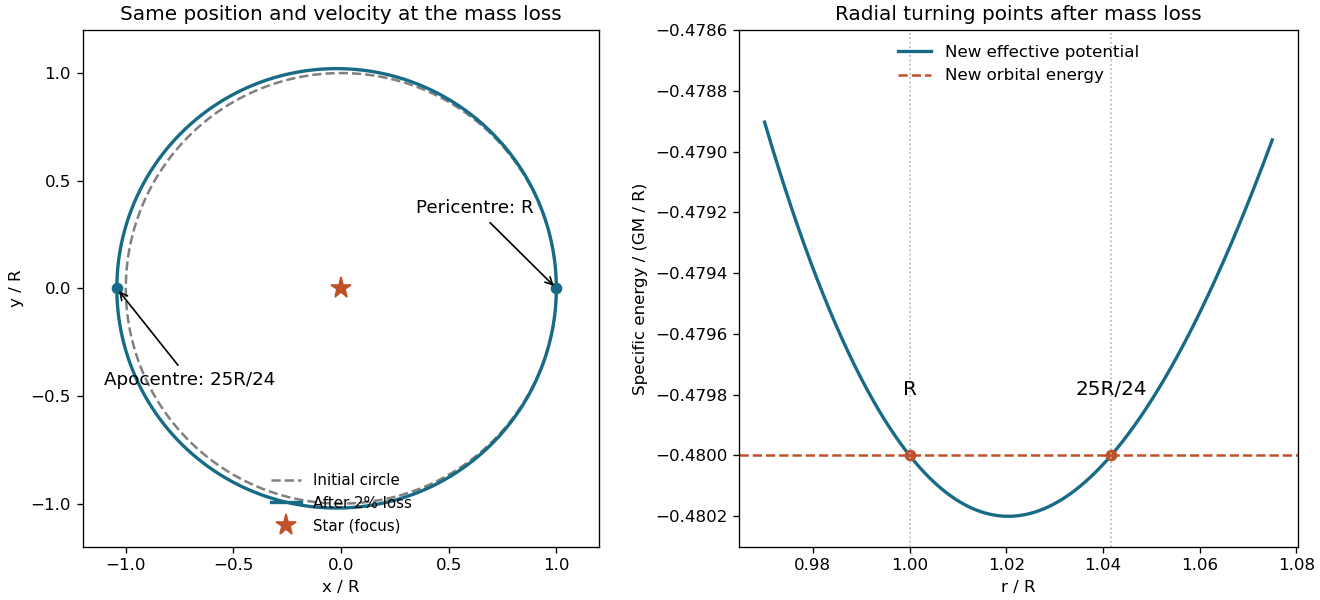
Original effective potential comparison and turning radii after an instantaneous two-percent central mass loss
. Details. 
The figure retains the same angular momentum before and after the change. Once the expelled material is far away, a spherically symmetric outer shell exerts no interior gravitational force by the shell theorem; direct ejecta interaction and the shell's finite transit time are neglected as in the source idealization.
New to topics? Read the docs here!