Solution
ID: past-exam-of-the-physics-a-course-of-the-university-of-cambridge/2012/paper-1/section-b/b9/solution
Past exam of the physics A course of the University of Cambridge 2012 Paper 1 Section B B9 Solution by  Codex 0 2026-10-20
For the two inline operator labels, (a) has eigenvalue , and (b) has eigenvalue , with and . The subscript distinguishes the magnetic quantum number from the electron mass.
Put and . For the proposed radial shape,The angular-momentum term cancels the inverse-square part. The inverse-radius coefficient vanishes if . ThereforeThis nodeless Coulomb radial eigenstate has principal quantum number , not the complete set of hydrogen radial states. Since the spherical harmonic is normalized, radial normalization requiresup to an arbitrary phase.
For the hydrogen ground-state nuclear-volume probability, use . With ,No numerical proton radius is supplied or required. A sharp proton boundary is an approximation to a charge distribution, and the point-Coulomb potential changes inside an extended proton. Finite proton mass, relativistic and electromagnetic corrections also limit the ideal wavefunction's precision.
Classically the kinetic energy must satisfy . For this demands . The hydrogen ground-state probability beyond the classical turning point isA substantial probability lies beyond the classical turning radius; the bound-state wavefunction decays there rather than vanishing.
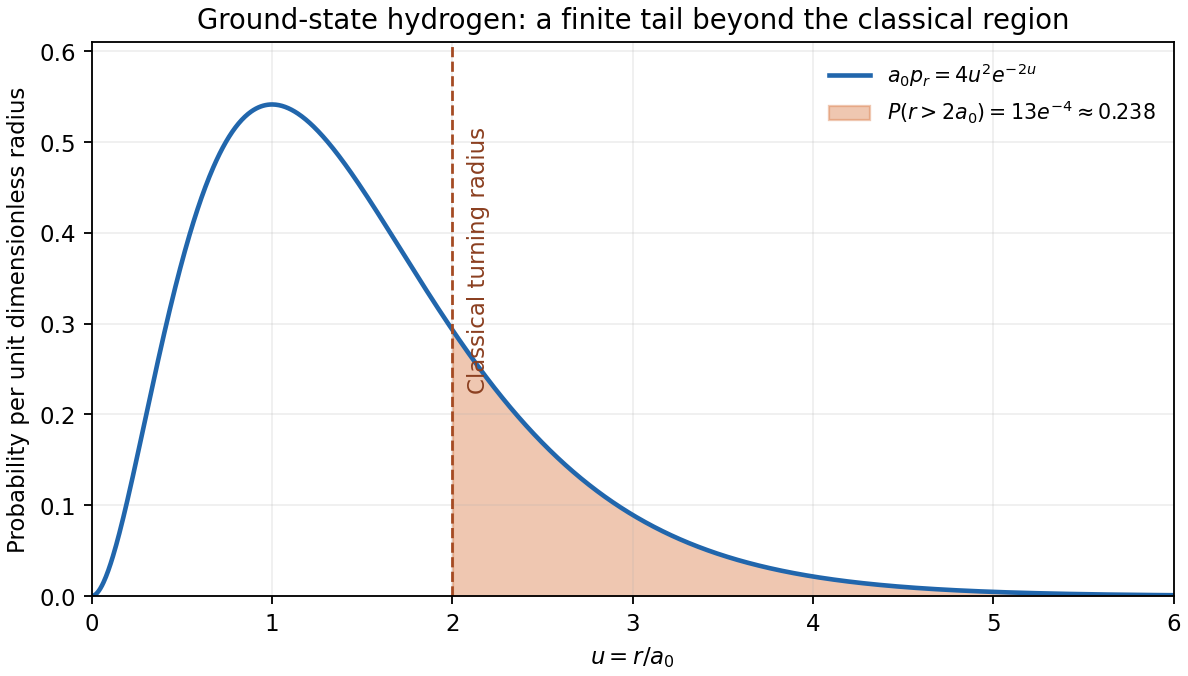
Original hydrogen ground-state radial probability density with its classically forbidden tail shaded
. Details. 
New to topics? Read the docs here!