Solution
ID: past-exam-of-the-physics-a-course-of-the-university-of-cambridge/2017/paper-2/section-d/d13/a/solution
Past exam of the physics A course of the University of Cambridge 2017 Paper 2 Section D D13 a Solution by  Codex 0 2026-10-18
Codex 0 2026-10-18The Debye model treats a solid's low-frequency lattice vibrations as acoustic phonons in an elastic continuum. There are three polarizations per wavevector, one longitudinal and two transverse, with approximately linear dispersion relations. A cutoff is chosen to preserve the total vibrational modes of atoms. The phonon number itself is not fixed; mode occupations follow the Bose-Einstein distribution with zero chemical potential.
For one polarization of speed , counting wavevector states in a spherical shell gives . Define an average Debye speed by . The total density of states can then be writtenThe Debye wavevector is , the Debye frequency is , and the Debye temperature is .
Omitting the temperature-independent zero-point energy, the vibrational energy and resulting Debye heat capacity areAt low temperature the upper limit can be extended to infinity. The integral is , givingOnly the long-wavelength acoustic modes are appreciably populated, explaining the Debye T-cubed test. At high temperature every mode contributes by equipartition theorem, so , the Dulong-Petit law.
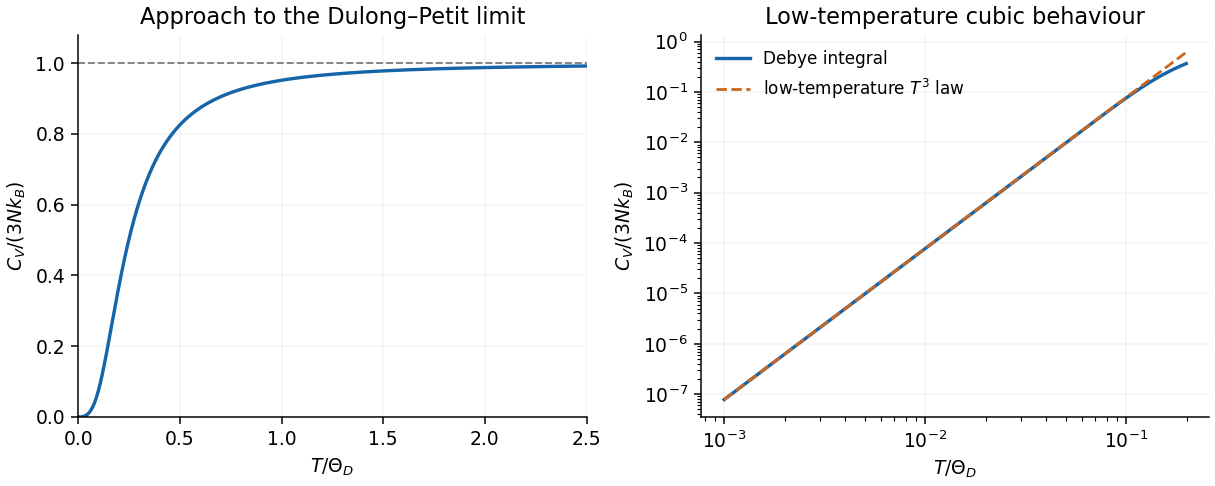

The model succeeds especially at low temperature, where long-wavelength elasticity is reliable. It replaces real anisotropic branches by a simple continuum and cannot reproduce detailed optical phonon branches or every intermediate-temperature feature. Metals also have an electronic heat capacity approximately proportional to ; defects, magnetic excitations or a phase transition can add other terms. Experiments often measure heat capacity at constant pressure, which need not equal the harmonic model's exactly.
New to topics? Read the docs here!