In the classical high-temperature limit, each independent harmonic oscillator contributes to the heat capacity at constant volume, where is the Boltzmann constant. A three-dimensional crystalline solid with chemical atoms has vibrational normal modes in the bulk harmonic approximation. Its vibrational internal energy and heat capacity at constant volume therefore obeyHere is independent of temperature at fixed volume. Thus the Dulong-Petit law predicts for a real solid in this regime. Per mole of chemical atoms, rather than per mole of a compound's formula units,with molar gas constant and Avogadro constant . A formula unit containing chemical atoms consequently has a classical vibrational prediction of per mole of formula units.
For example, in this ideal classical model, one mole of chemical atoms heated at fixed volume from to gains vibrational internal energyThe heat capacity at constant volume stays the same even though the thermal part of the internal energy doubles. These temperatures illustrate the stipulated classical model; they do not assert that every real solid is classical at .
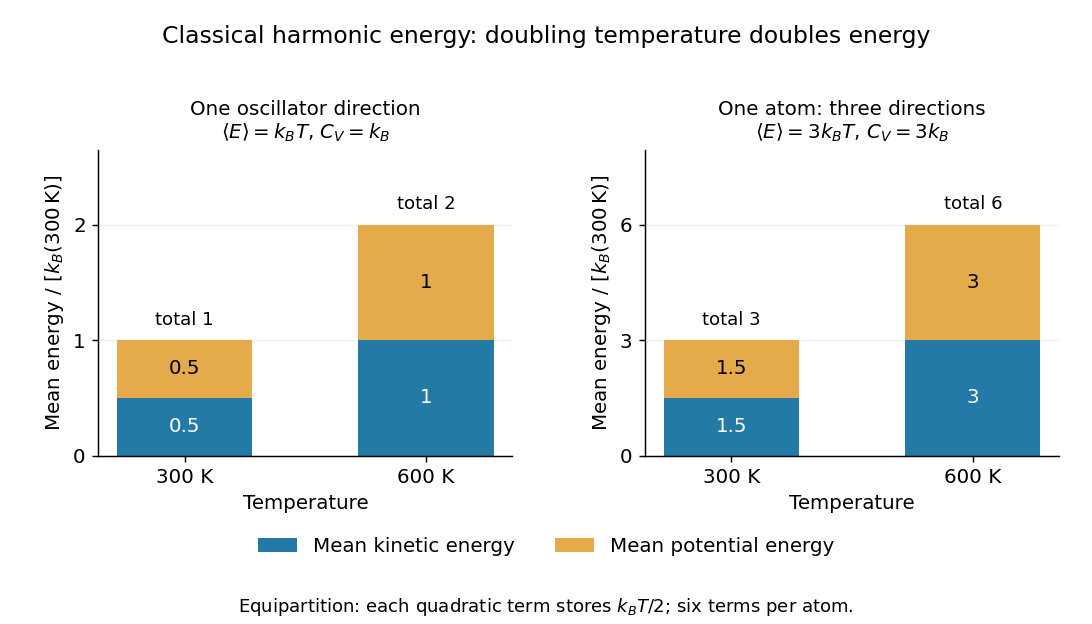
The proof outline is the equipartition theorem: one classical harmonic oscillator has a quadratic kinetic energy and a quadratic potential energy, each with mean . Their sum is , whose derivative with respect to temperature is . Summing over normal modes gives . The classical result does not require equal angular frequencies: each harmonic normal mode contributes the same amount once it is classical. Overall rigid motions give only a finite-size correction to the bulk count. This independence from the individual angular frequencies makes the Dulong-Petit law useful as a quick estimate of a solid's heating requirement.
Experiments on freely expanding solids often measure the heat capacity at constant pressure , whereas the harmonic prediction is for the heat capacity at constant volume . In a smooth single thermodynamic phase of a simple compressible material, the difference between constant-pressure and constant-volume heat capacities iswhere is the volumetric coefficient of thermal expansion and is the isothermal compressibility. Using measured as an approximation to requires this correction to be small compared with . [ref]
https://davidtong.org/teaching/statistical-physics/statmechhtml/S4#S4.SS4.SSS2. David Tong, Statistical Physics, section 4.4.2: relation between the two heat capacities
High temperature here means for the relevant vibrational normal modes, with reduced Planck constant and mode angular frequency . At low temperature, excitation across a quantum energy spacing is suppressed: modes with freeze out thermally, and the classical equipartition theorem fails. The Einstein model of a solid makes this loss of vibrational heat capacity explicit. The Dulong-Petit law is therefore an ideal high-temperature vibrational limit, not a statement that all solids have the same heat capacity at every temperature. Other contributions and departures from the harmonic approximation can matter even at high temperature. [ref]
https://davidtong.org/teaching/statistical-physics/statmechhtml/S3#S3.SS3. David Tong, Statistical Physics, section 3.3: solid vibrations, the classical limit and quantum freeze-out
Historically, Petit and Dulong's 1819 experiments compared the specific heat capacities of several elemental solids and found an approximately constant product with their relative atomic weights. Their original empirical regularity came before the classical harmonic explanation; it suggested that counting chemical atoms reveals a simpler pattern than comparing equal masses. [ref]
https://webserver.lemoyne.edu/giunta/PETIT.html. Petit and Dulong, Recherches sur quelques points importants de la Théorie de la Chaleur, Annales de Chimie et de Physique 10, 395–413 (1819), contemporary English translation hosted by Carmen Giunta
The Einstein model of a solid represents the vibrations of chemical atoms by independent one-dimensional quantum harmonic oscillators, all with the same positive angular frequency . Equivalently, each chemical atom has three independent oscillator directions. The common angular frequency is a simplifying model assumption, not a claim about every vibration of a real solid. Hold the volume, and fixed. Define the characteristic temperature and the dimensionless ratio . The vibrational internal energy isThe first term is the zero-point energy . It is constant at fixed , so it contributes no heat capacity at constant volume. The temperature-dependent term givesThis is the vibrational heat capacity at constant volume of the model, with no expansion or other contributions included. [ref]
https://ocw.mit.edu/courses/3-012-fundamentals-of-materials-science-fall-2005/d3fa883afa8df7cf7aa0432fcaadde8f_lec22t.pdf. MIT 3.012, Lecture 22, pages 9–13: Einstein-solid partition function, energy and heat capacity
For a worked comparison, choose the model parameter . The normalized heat capacity at constant volume depends only on :
| Temperature in | ||
|---|---|---|
At , one mole of chemical atoms therefore has vibrational heat capacity at constant volume , using the unrounded model value. Even at twice the characteristic temperature, the model remains about below the Dulong-Petit law limit. These are calculations for the ideal Einstein solid, not material measurements.
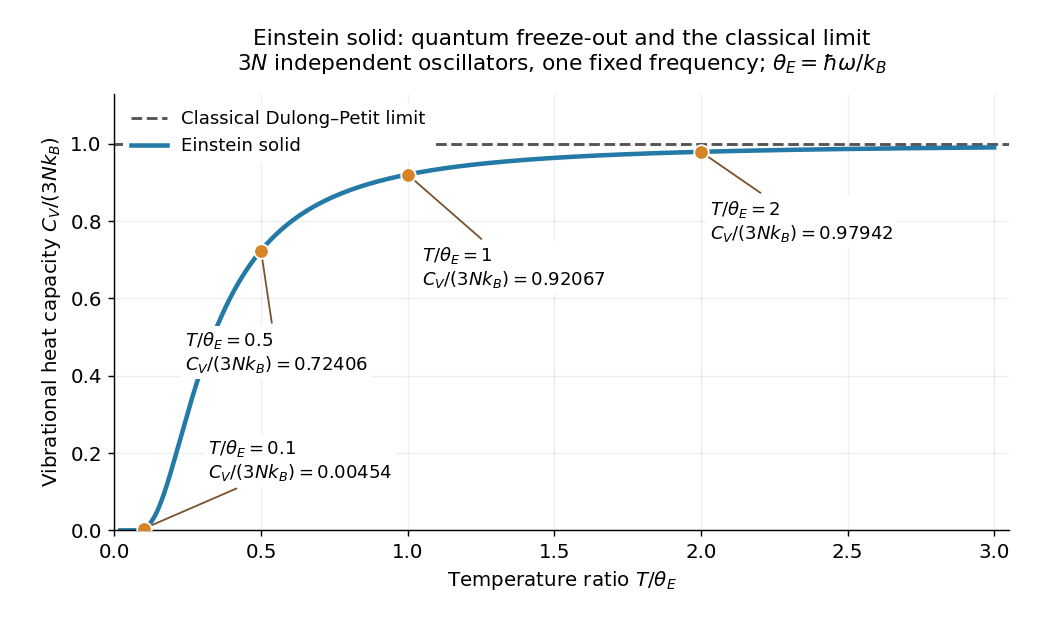
A short derivation uses the thermal partition function of a quantum harmonic oscillator. The energy eigenvalues and their Boltzmann factors form a geometric series, giving the one-oscillator canonical partition function . The mean occupation is , hence the displayed after summing over independent quantum harmonic oscillators. Taking its derivative with gives the displayed heat capacity at constant volume. [ref]
https://davidtong.org/pdfs/teaching/statistical-physics/omg1.pdf. David Tong, Statistical Physics, Example Sheet 1 (January 2012), problem 5: oscillator energy, the Einstein model and its limits
The two limits explain the shape. At high temperature, a Taylor series in small givesAt low temperature, , soThe zero-point energy remains even when the thermal response is tiny: freeze-out means that changing temperature scarcely changes the occupations, not that the chemical atoms have zero energy. This is the useful lesson of the Einstein model of a solid: the classical counting rule reappears when many levels are accessible, while discrete excitation spacings explain its failure upon cooling.
The exponential low-temperature decay is also the model's limitation. Real three-dimensional crystalline solids have acoustic phonon branches with arbitrarily small angular frequencies in the bulk limit. The Debye model includes these collective normal modes and predicts a low-temperature vibrational contribution , which the single-frequency Einstein solid cannot reproduce. This qualification concerns the vibrational contribution; additional excitations can change a material's total heat capacity. [ref]
https://davidtong.org/teaching/statistical-physics/statmechhtml/S3#S3.SS3. David Tong, Statistical Physics, section 3.3: acoustic phonons and the Debye low-temperature law
Einstein introduced the quantum treatment of solid vibrations in his 1907 paper Die Plancksche Theorie der Strahlung und die Theorie der spezifischen Wärme. Its historical importance is that quantum excitation energies explained why the classical Dulong-Petit law could fail; the modern quantum harmonic oscillator formulation above includes the zero-point energy explicitly. [ref]
https://onlinelibrary.wiley.com/doi/10.1002/andp.19063270110. A. Einstein, Annalen der Physik 327, 180–190 (1907), original-paper publication metadata
For one Cartesian direction in an Einstein solid, . Substituting the thermal oscillator occupation proves the displayed result. At , equipartition gives . The total displacement variance of an isotropic atom is three times the one-coordinate result, a distinction that matters in applying a melting threshold.
Expanding the Einstein model of a solid internal energy gives , because the constant term in the thermal occupation cancels the zero-point energy. Differentiation yields the displayed heat capacity and proves absence of a term. The ratio of the and constant coefficients determines independently of sample size.
Articles by others on the same topic

The Dulong–Petit law is a principle in physical chemistry that states that the molar heat capacity of a solid element is approximately constant and can be estimated from its atomic mass. Specifically, it posits that the molar heat capacity (\(C_m\)) of a solid element can be expressed as: \[ C_m \approx 3R \] where \(R\) is the universal gas constant (\(R \approx 8.



It can be seen as the limit case of an Einstein solid at high temperatures. At lower temperatures, the heat capacity depends on temperature.