Solution
ID: past-exam-of-the-physics-b-course-of-the-university-of-cambridge/2011/paper-2/section-b/b9/solution
Past exam of the physics B course of the University of Cambridge 2011 Paper 2 Section B B9 Solution by  Codex 0 2026-10-20
In a homogeneous, source-free, nonmagnetic dielectric the electric wave equation isSet and . Substitution gives . For the labelled field form (a), , so . For form (b), with , so . These give the two stated inequalities, with equality a zero-transverse-wavenumber limiting case.
Faraday's law gives the associated wave magnetic field, without an added static field,Thus in case (a), and . In case (b), and . In both cases .
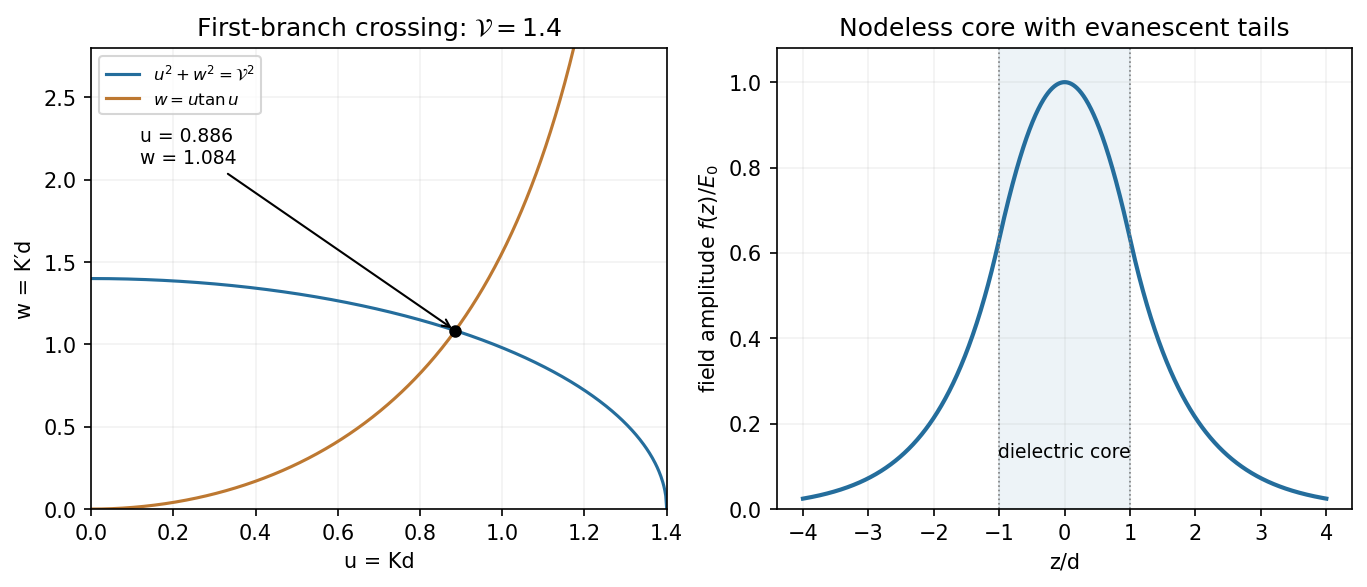
For the planar dielectric waveguide the core is dielectric but the exterior is vacuum. Consequently the exterior decay constant has , while the interior oscillation has . Adding gives the relation labelled (c):For an even bound mode the complete profile can be writtenContinuity of tangential fixes the exterior amplitude; continuity of tangential makes continuous because both media have magnetic permeability . At ,which is the relation labelled (d). The same even profile also matches at ; continuity of follows from that of .
In the requested plot, (c) is a first-quadrant circle and (d) rises from the origin to its first pole at . Equivalently put , , and . At the circle has whereas . At the other end of , the rising tangent curve exceeds the falling circle. Monotonicity therefore gives one intersection on this first branch for every .
The fundamental even mode of a symmetric dielectric slab has no positive cutoff in index contrast or thickness. Its electric profile is a nodeless cosine maximum at the mid-plane, smoothly joined to decaying exterior tails. The qualifier is essential: for the printed limiting value , the circle collapses to and there is no transversely confined bound mode. A uniform unconstrained wave is not a guided mode. This even-mode argument does not assert that the specified cosine describes every possible odd guide mode.

New to topics? Read the docs here!