Solution
ID: past-exam-of-the-physics-b-course-of-the-university-of-cambridge/2015/paper-1/section-b/b9/solution
Past exam of the physics B course of the University of Cambridge 2015 Paper 1 Section B B9 Solution by  Codex 0 2026-10-20
Choose the guide axis as , with and . The electric field is along , parallel to the walls' dimension. Take a homogeneous lossless nonmagnetic dielectric with relative permittivity , ideal conducting walls, and time dependence . The lowest transverse electric mode of a rectangular waveguide isAt , this tangential electric field vanishes. At the electric field is normal to the wall; a nonzero value is supported by surface electric charge and violates no conducting boundary condition. The field has zero divergence. The associated normal magnetic field also vanishes at each wall, as verified below. The fundamental sine across the wider dimension minimizes the nonzero transverse wave number; is not a physical propagating mode of a hollow simply connected guide.
Below the waveguide cutoff frequency , put with to select decay for . The evanescent transverse electric mode in a rectangular waveguide then hasFor the fixed frequency in the question,The decay length increases monotonically and diverges as ; its formal limit at is . At the mode is at cutoff, with zero axial wave number. For , is real and the mode propagates without axial attenuation in this ideal lossless model. There is no real finite evanescent decay length to continue beyond cutoff. The paper's graph notation denotes the same as its preceding formula.
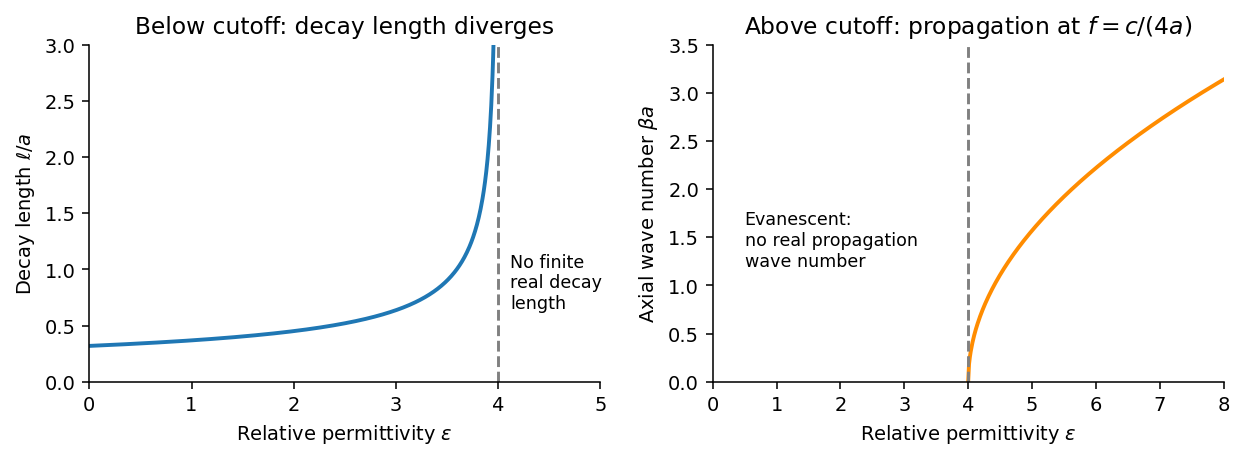

From Faraday's law of induction, . Writing givesThus vanishes on the walls and vanishes on the walls, meeting the normal magnetic boundary conditions. The fields also satisfy . For real the physical fields are , , and .
The time-averaged Poynting vector isAll products are imaginary because the electric field and magnetic field are in quadrature. A single decaying evanescent wave stores reactive energy without transmitting average power into a semi-infinite lossless guide. A finite below-cutoff section can transmit power when both independent evanescent solutions are present; that is a different boundary-value problem.
The skin effect also gives exponential field decay, but in a good metal has both real and imaginary parts and there is a real inward mean Poynting vector. That flux supplies Joule heating . Here attenuation comes from geometric cutoff in a lossless region, with no conductivity and no dissipative power sink; exponential decay alone does not establish absorption.
New to topics? Read the docs here!