Solution
ID: past-exam-of-the-physics-course-of-the-year-1-of-the-natural-sciences-course-of-the-university-of-cambridge/2013/paper-1/section-d/d13/solution
Past exam of the physics course of the year 1 of the natural sciences course of the University of Cambridge 2013 Paper 1 Section D D13 Solution by  Codex 0 2026-10-20
Substitution into the wave equation gives and . Therefore . The fixed edges at zero are automatically satisfied by the sine factors; the opposite edges requireNeither integer may vanish, because that would make the entire displacement zero.
The element's mass is , and its speed is . Squaring and multiplying by half its mass gives the requested energy density. The two sine-squared spatial integrals are and , soThere is no dissipation. The total mechanical energy equals the maximum kinetic energy, givingEquivalently, integrate the small-slope tension energy and use the dispersion relation.
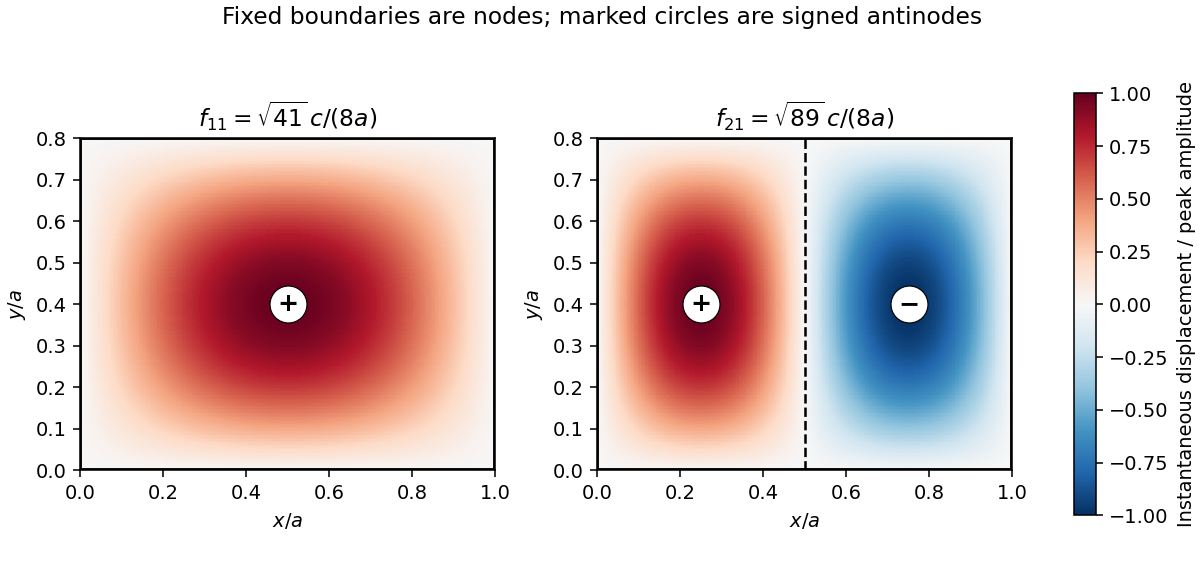
For , the two lowest modes are and :The fundamental has one antinode at and no interior nodal line. The next mode has a node along and opposite-sign antinodes at and . Every boundary is a node.

New to topics? Read the docs here!