Solution
ID: past-exam-of-the-physics-course-of-the-year-1-of-the-natural-sciences-course-of-the-university-of-cambridge/2015/paper-1/section-b/b9/solution
Past exam of the physics course of the year 1 of the natural sciences course of the University of Cambridge 2015 Paper 1 Section B B9 Solution by  Codex 0 2026-10-20
For a particle of rest mass , and , with . The low-speed expansion is , separating invariant rest energy from the nonrelativistic kinetic energy term.
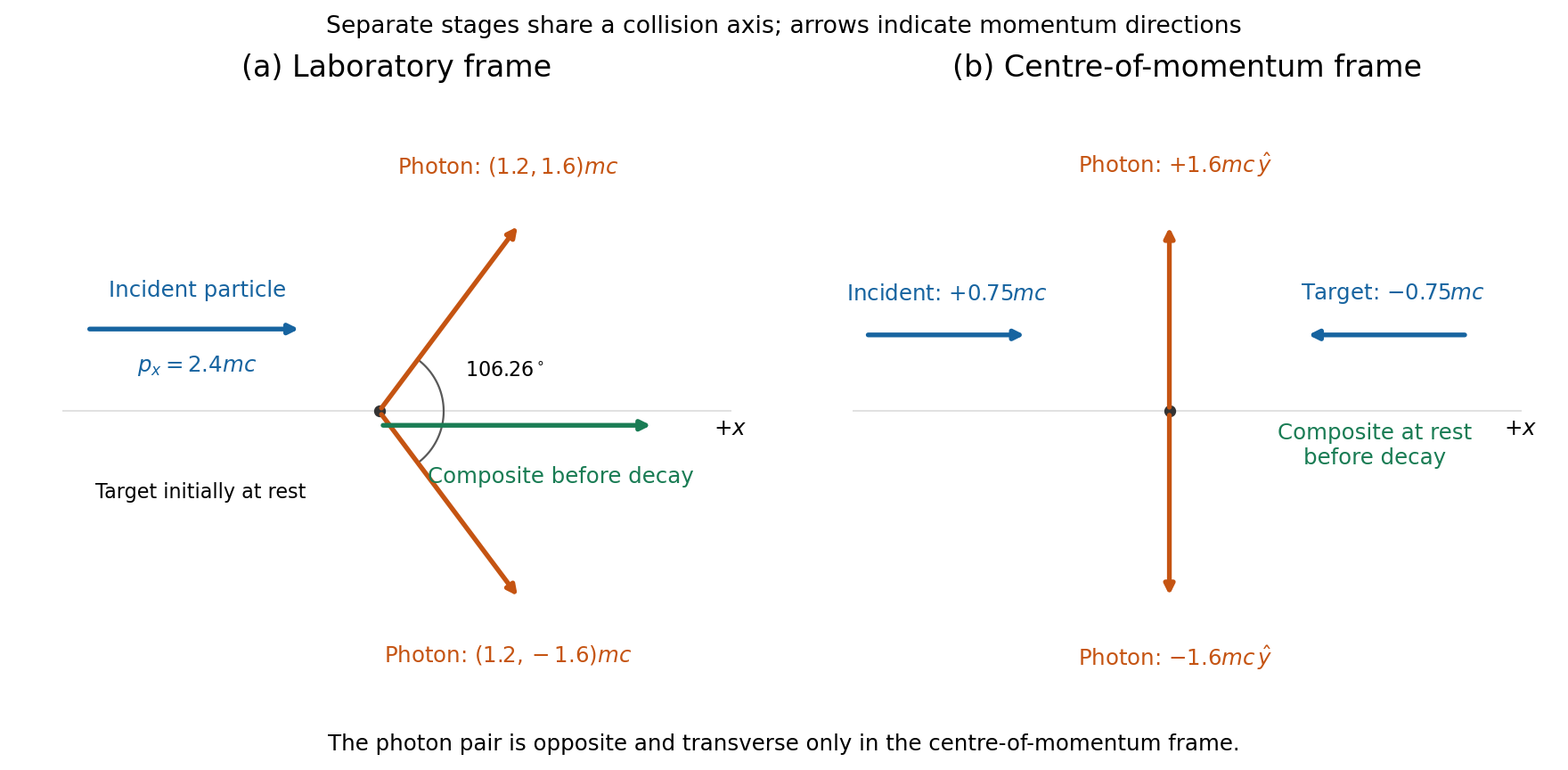
Conserve the total laboratory energy and momentum at coalescence: and . Since , the combined particle moves at . Its rest mass is . The incident particle is not of mass : its stated energy and momentum imply . ThusThe extra is internal rest energy retained by the composite after a perfectly inelastic collision; total energy and four-momentum are conserved, while the sum of individual rest masses need not be.
The composite's Lorentz factor is . For a rest-frame lifetime , the corresponding laboratory time is and its travel distance isIf denotes a mean radioactive lifetime, this is the mean flight distance, not a fixed distance for every decay. The separate frame diagrams below use the common positive collision axis.

New to topics? Read the docs here!