Solution
ID: past-exam-of-the-physics-of-atmospheres-and-oceans-course-of-the-university-of-oxford/2016/3/solution
Past exam of the physics of atmospheres and oceans course of the University of Oxford 2016 3 Solution by  Codex 0 2026-10-25
Normalization and angular pattern. A scattering phase function describes the distribution of single-scattered power over outgoing solid angle, for a specified incident direction, wavelength and polarization convention. Use the common normalizationThe scattering asymmetry parameter is the mean cosine of the scattering angle: forward scattering has positive , backward scattering negative , and a forward–backward symmetric pattern has .
Let . The given small-sphere angular intensity is , where . Its total scattered power isNormalizing givesDimensionally the supplied is radiant intensity, power per solid angle. If interpreted as detector irradiance at a distance, the appropriate inverse-square distance factor is also needed; it cancels out of the normalized angular pattern.
The polar plot has equal forward and backward lobes, each with radius , and lateral values . A small nonabsorbing particle behaves as an induced electric dipole. Radiation transverse to the dipole and the average over two orthogonal incident polarizations produce the form. Its odd angular moment vanishes:As the size parameter grows, Rayleigh scattering in the electric-dipole approximation no longer suffices. Higher multipoles and interference produce structure in the angular pattern, and large particles generally develop a strong narrow forward diffraction peak. Their is normally positive, although detailed values and angular features depend on refractive index, size distribution and shape; they are not fixed by radius alone. Large spheres may show rainbows and backscattering structure, while nonspherical ice introduces further angular features.
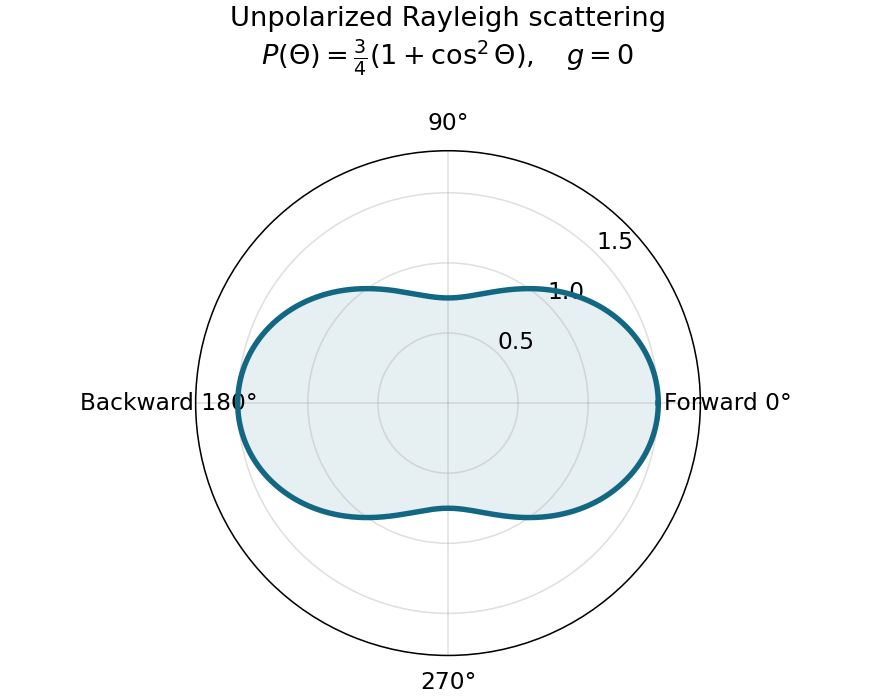
Normalized Rayleigh phase function for an unpolarized incident beam
. Details. 
Optically thick transmission. In a nonabsorbing two-stream or transport approximation, it is the transport optical depth that controls the loss of forward directional memory. Using the same idealized albedo closure as in option 1 gives total forward-hemisphere transmittanceFor the same large but finite extinction optical depth,The respective transport-depth factors are , and . The water cloud scatters most strongly forward and returns the least light backward. All transmittances tend to zero in the infinite-depth limit. The strictly unscattered direct-beam transmittance is instead , identical in the three cases: the ranking concerns total transmitted radiation, including forward-scattered light, not that direct component alone. Full radiative transfer can also depend on higher angular moments beyond .
New to topics? Read the docs here!