Solution
ID: past-exam-of-the-physics-of-atmospheres-and-oceans-course-of-the-university-of-oxford/2018/1/b/solution
Past exam of the physics of atmospheres and oceans course of the University of Oxford 2018 1 b Solution by  Codex 0 2026-10-25
Take the convection to maintain a dry, nearly reversible adiabat, with specific gas constant . Hydrostatic equilibrium and an ideal-gas equation of state will be used separately to convert pressure to height. For an adiabatic displacement, the first law of thermodynamics in enthalpy form givesThe adiabat with linear heat capacity follows by integrating from the surface: this gives the monotone implicit temperature–pressure relationAn explicit form, using the positive real Lambert W branch, isAs , . At fixed ,Larger heat capacity therefore keeps the upper atmosphere warmer at the same pressure. Equivalently becomes smaller. The original normalized sketch below shows the resulting family of profiles; no particular gas constants or surface temperature are assumed there.
The height equations areIntegrating the latter givesThe physically selected root starts at and decreases. Its formal upper boundary isAt that height and . The limit is . This finite-height zero is a property of the assumed polytropic-like model, not a claim that a real atmosphere reaches absolute zero: molecular heat capacities, composition, transport and the continuum ideal-gas description cease to support that extrapolation.
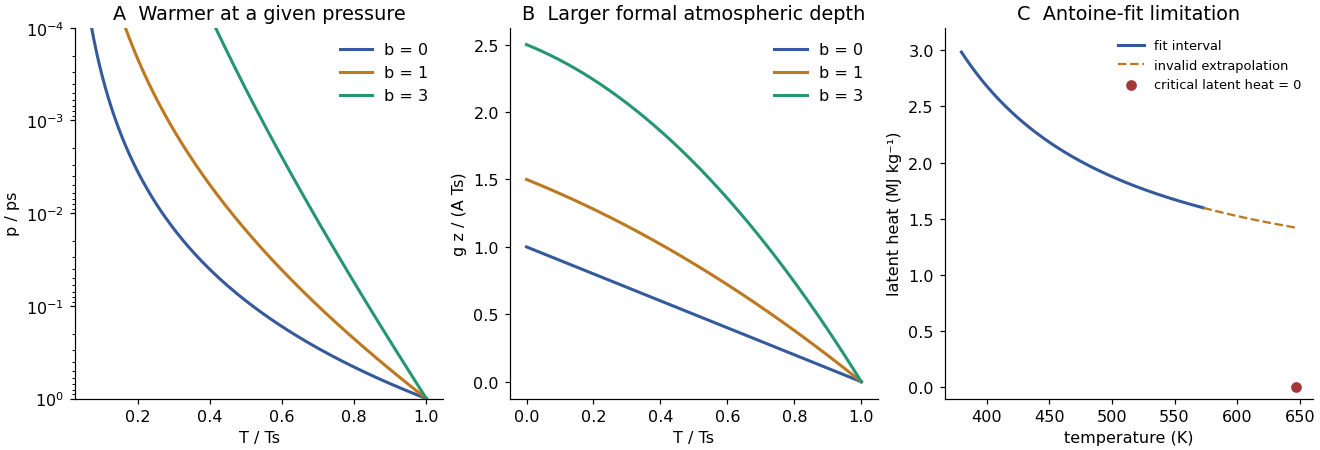
Adiabats with increasing heat capacity and the limited-temperature latent heat inferred from an Antoine fit
. Original calculations. Adiabats use dimensionless parameters and ; the latent-heat plot distinguishes the stated fit range from an invalid extrapolation toward the known critical point. Details.
New to topics? Read the docs here!