
Latent heat is the heat absorbed or released in a first-order phase transition through its entropy jump. For an equilibrium conversion from thermodynamic phase to thermodynamic phase at fixed pressure, evaluate both thermodynamic phases at the same temperature and pressure on their phase coexistence curve:Use one normalization throughout: , and may all be per mole, giving in , or all per unit mass, giving in . Here is entropy and is enthalpy on that basis. Equal Gibbs free energies of the coexisting thermodynamic phases give . Identifying this enthalpy difference with supplied heat assumes a closed system and an equilibrium conversion with only pressure-volume work. [ref]
For a pure substance with positive latent heat per unit mass , let be the phase fraction of the higher-enthalpy thermodynamic phase, measured by mass. While both thermodynamic phases coexist at the fixed pressure,Adding heat changes rather than the temperature; this creates the horizontal portion of a heating curve. Once , additional heat raises the temperature according to specific heat capacity at constant pressure. Reversing the conversion releases heat. The plateau represents changing enthalpy, rather than a finite single-thermodynamic phase heat capacity satisfying . [ref]
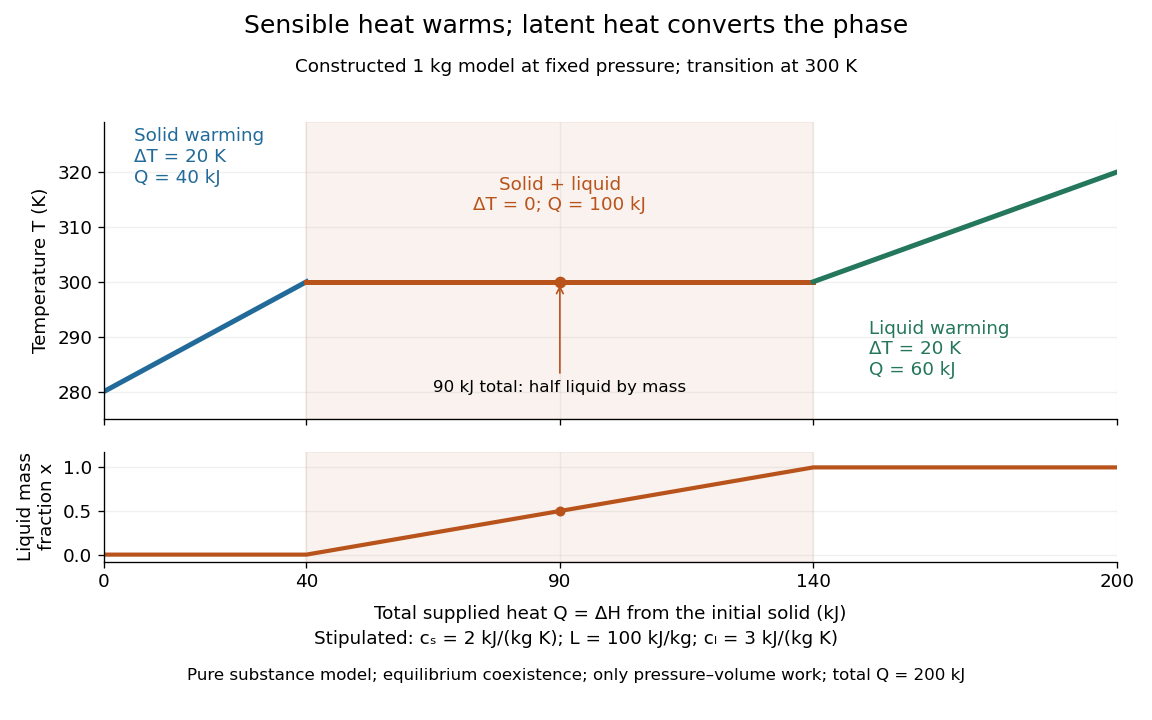
For a constructed fixed-pressure model, take , initial temperature , transition temperature , solid specific heat capacity at constant pressure , latent heat , and liquid specific heat capacity at constant pressure . These are stipulated model parameters, not empirical properties of a named material. Heating the solid to takes of sensible heat; converting it fully to liquid takes another of heat; heating the liquid to takes . The total is . After a total heat input of , and the temperature is still . The corresponding per-unit-mass entropy jump is .
A continuous phase transition has no latent heat. Its heat capacity can have a jump or a singularity without a finite interval in which added heat converts coexisting thermodynamic phases at a constant temperature. A heating plateau therefore requires the stated phase coexistence conditions; it is not a feature of every phase transition. [ref]
Statistical Physics by David Tong. Tong, Statistical Physics, first-order and continuous transitions


New to topics? Read the docs here!