Solution
ID: past-exam-of-the-physics-of-nanoelectronic-systems-course-of-the-university-of-cambridge/2013/paper-1/3/b/solution
Past exam of the physics of Nanoelectronic Systems course of the University of Cambridge 2013 Paper 1 3 b Solution by  Codex 0 2026-10-20
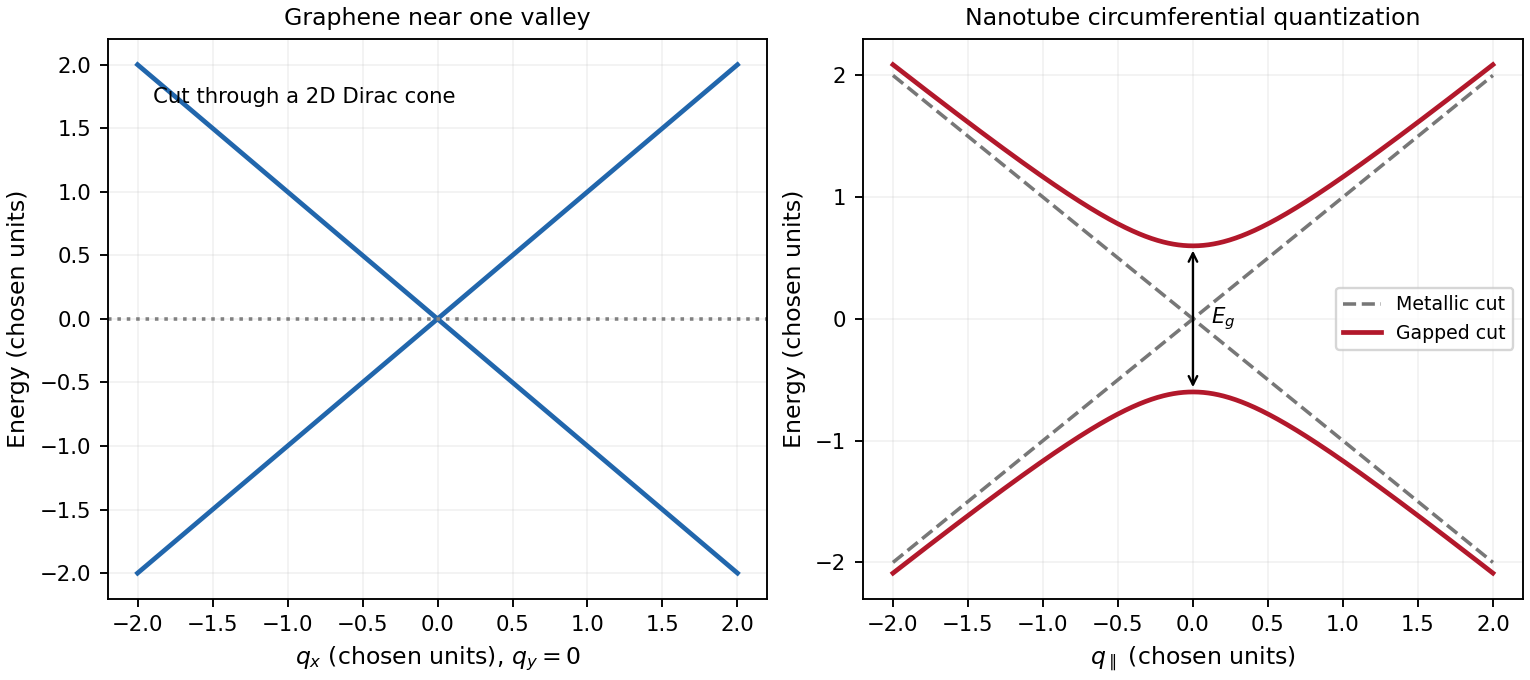
graphene is a two-dimensional honeycomb lattice with two sublattices. Nearest-neighbour hopping gives two bands . They touch at two inequivalent valleys. Expanding near valley givesThe two-component spinor describes sublattice amplitudes, not real spin. This is a massless two-dimensional Dirac Hamiltonian with material velocity in place of . The emergent band quasiparticles are relativistic in this mathematical sense; the electron's vacuum rest mass is not set to zero. Real spin and valley each contribute a degeneracy of two in the ideal low-energy model.
A single-walled carbon nanotube is a rolled graphene sheet with carbon nanotube chiral vector . Periodicity requires , selecting lines through graphene momentum space and producing one-dimensional transverse electronic modes. Near a valley,A quantization line through one of the Dirac valleys in graphene gives a metallic branch; ideal nanotube zone folding gives the criterion . Otherwise the nearest line misses the valley and opens . The transverse momentum gives a carbon-nanotube Dirac mass, with . For a large-radius ideal semiconducting tube, and , showing the inverse-diameter gap. Curvature, strain, spin-orbit coupling and interactions can change the simple classification; nominally metallic non-armchair tubes can acquire small gaps. One-dimensional transverse electronic mode thresholds give Van Hove singularities, unlike graphene's low-energy density of states proportional to .
A gate changes occupation and the Fermi level in both systems. Ideal monolayer graphene can be tuned through charge neutrality from holes to electrons, but an ordinary scalar gate does not open a bulk band gap. Including spin and valley,The gate relation includes geometric and quantum capacitances, so one should not equate gate voltage to Fermi energy without the capacitance model. A semiconducting carbon nanotube can instead be depleted when its Fermi level lies in a gap and turned on in electron or hole bands. Contact Schottky barriers can strongly influence the observed nanotube field effect. A truly gapless ideal metallic tube cannot be switched off simply by moving the Fermi level through its band crossing. These gate responses reflect band structure and contacts, not a change of wrapping indices.

New to topics? Read the docs here!