Solution
ID: past-exam-of-the-quantum-condensed-matter-course-of-the-university-of-cambridge/2015/paper-1/4/solution
Past exam of the quantum condensed matter course of the University of Cambridge 2015 Paper 1 4 Solution by  Codex 0 2026-10-20
Assume three-dimensional parabolic band edges, with density-of-states masses and one valley per edge, each with spin degeneracy two. Their effective densities of states areFor the semiconductor mass-action law, integrating the square-root density of states against the Boltzmann tail gives and . Multiplication cancels the chemical potential, givingIf there are additional valley degeneracies, multiply by their product; anisotropic bands use the appropriate density-of-states masses. In the later equal-mass model, . No numerical mass or valley multiplicity has been invented.
When , the conduction-edge occupation is exactly , so the nondegenerate approximation for electrons fails at every positive temperature. Define the Normalized complete Fermi-Dirac integralFor the carrier densities with chemical potential pinned to a band edge, with the two specified equal masses, put . Direct Fermi-Dirac integration then givesThus exactly within the parabolic model. At low temperature, is thermally activated; at , from below. Both vanish at zero temperature and increase at fixed chemical potential. The other states that pin can supply the compensating charge; one must not additionally impose .
For the Pauli reduction of the pinned-edge mass-action product, the exact product relative to the classical law isIt approaches at low temperature and in the formal high-temperature limit. The low-temperature activation factor is unchanged but its prefactor is reduced; the classical mass-action formula overestimates the product. The high-temperature limit here refers to the given unbounded parabolic bands, not a claim that real semiconductor band structures remain unchanged at arbitrarily high temperature.[ref]
Quantum Gases by David Tong. Sections 3.1 and 3.6.1–3.6.4: density of states, Fermi occupation and Sommerfeld expansion
Finally, for a fixed positive , the zero-temperature Fermi sphere has radius , soThe low-temperature expansion at fixed gives the fixed-chemical-potential Sommerfeld density increase:The monotonic density at fixed chemical potential in a square-root density of states initially rises quadratically from . For , its leading behaviour crosses to . The fixed chemical potential is what allows the particle number to change.
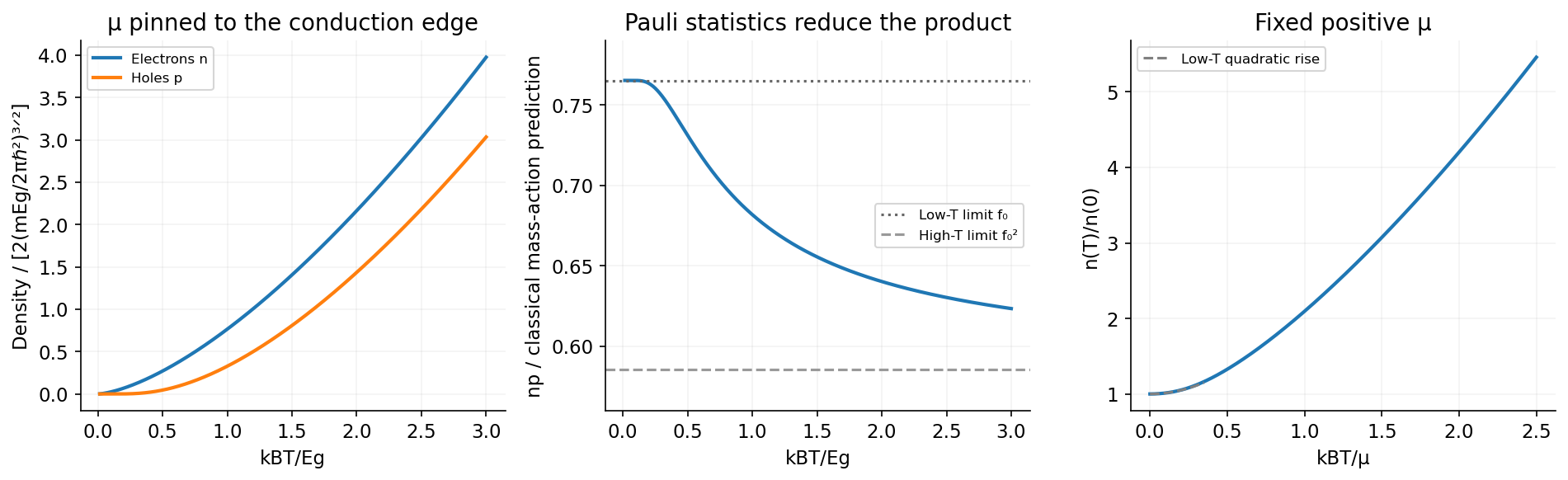
Pinning the chemical potential to or above a band edge changes carrier populations and the mass-action product
. Source. Details. 
New to topics? Read the docs here!